
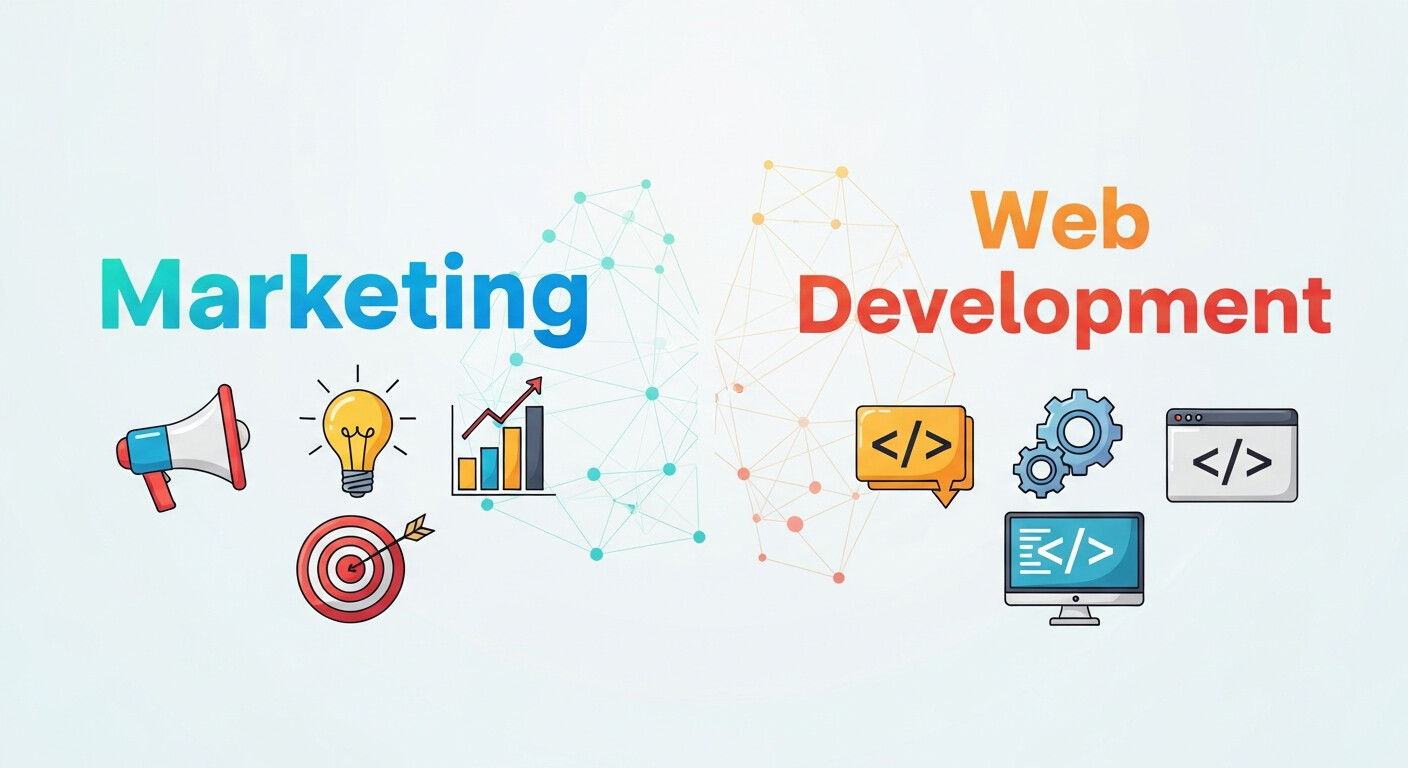
Marketing and web development might seem like separate worlds, but they’re actually two sides of the same coin. When these teams collaborate effectively, they create websites that don’t just look good—they convert visitors into customers and drive real business results.
Most businesses treat marketing and web development as isolated departments. Marketing focuses on campaigns and lead generation, while developers build functional websites. However, this siloed approach often leads to missed opportunities, poor user experiences, and websites that fail to achieve their business goals.
This post explores why marketing and web development must work hand-in-hand, the benefits of this collaboration, and practical strategies for bringing these teams together to create high-performing websites.
Why Marketing and Web Development Need Each Other
Marketing Provides the Strategy, Development Delivers the Experience
Marketing teams understand customer behavior, pain points, and conversion paths. They know what messages resonate with different audience segments and which calls-to-action drive the most engagement. Web development teams, on the other hand, have the technical expertise to bring these insights to life through code, design, and functionality.
When marketing operates without developer input, it might create campaigns that drive traffic to pages that can’t handle the load or don’t support the intended user journey. Similarly, when developers build websites without marketing insights, they often create technically sound but commercially ineffective sites.
Data-Driven Decision Making
Both teams rely heavily on data, but they often look at different metrics. Marketing focuses on conversion rates, lead quality, and customer acquisition costs. Web development teams monitor site performance, loading speeds, and technical functionality.
Combining these perspectives creates a more complete picture of website performance. For example, a marketing team might notice high bounce rates on a landing page, while developers can identify that slow loading times are the root cause.
Key Areas Where Marketing and Web Development Intersect
Search Engine Optimization (SEO)
SEO perfectly demonstrates why marketing and web development must collaborate. Marketing teams understand keyword research, content strategy, and user intent. Developers handle technical SEO elements like site structure, page speed optimization, and mobile responsiveness.
Effective SEO requires both teams to work together. Marketers identify the keywords and content opportunities, while developers ensure the site’s technical foundation supports search engine crawling and indexing. Without this collaboration, even the best content marketing efforts can be undermined by technical issues.
User Experience (UX) Design
Creating exceptional user experiences requires understanding both customer psychology and technical capabilities. Marketing teams bring insights about user preferences, behavior patterns, and conversion triggers. Developers contribute knowledge about what’s technically feasible and how to implement complex interactions smoothly.
Together, they can create websites that not only look appealing but also guide users naturally toward desired actions. This might involve A/B testing different layouts, optimizing form fields, or implementing progressive web app features that improve mobile experiences.
Conversion Rate Optimization (CRO)
CRO is where marketing strategy meets technical implementation. Marketing teams identify opportunities to improve conversion rates through user research, analytics, and testing. Developers then build the tools and functionality needed to implement these improvements.
This might involve creating custom landing pages, implementing advanced analytics tracking, or developing personalization features. The most successful CRO efforts combine marketing insights with technical innovation. Read more about this topic: Mastering Conversion Rate Optimization Strategies to Drive Success
Performance and Analytics
Website performance directly impacts marketing effectiveness. Page load times affect both user experience and search engine rankings. Marketing campaigns can drive significant traffic, but if the website can’t handle the load, all that effort goes to waste.
Developers ensure websites can handle traffic spikes and perform well across different devices and browsers. Marketing teams provide insights about when traffic spikes are likely to occur and what pages need to perform best.
Benefits of Integrated Marketing and Web Development
Faster Project Delivery
When marketing and web development teams collaborate from the start, projects move faster. Instead of marketing creating requirements and throwing them over the wall to developers, both teams can work together to find the best solutions.
This collaborative approach reduces back-and-forth revisions and ensures that technical constraints are considered during the planning phase. It also means that marketing campaigns can be designed with the website’s capabilities in mind.
Better User Experiences
Integrated teams create more cohesive user experiences. Marketing messaging aligns with website functionality, and the technical implementation supports the intended user journey. This results in websites that feel more polished and professional.
Improved ROI
When marketing and web development work together, businesses see better returns on their technology investments. Marketing campaigns perform better because they’re supported by well-designed websites. Development projects have clearer success metrics because they’re aligned with marketing goals.
Enhanced Innovation
Collaboration between these teams often leads to innovative solutions. Marketing teams might propose ideas that push developers to explore new technologies. Developers might suggest technical capabilities that open up new marketing opportunities.
Aligning Website Goals With Business Objectives
A website should never exist just to “look good.” It must directly support business goals such as lead generation, sales, brand awareness, or customer retention. Marketing teams understand these objectives and define what success looks like, while web developers translate them into functional website elements. When both teams collaborate early, every page, feature, and interaction is built with a purpose. Landing pages are designed to convert, navigation supports user journeys, and technical structures align with campaign goals. This alignment prevents wasted development effort and ensures marketing traffic leads to meaningful actions. A goal-driven website performs better because strategy and execution work together rather than against each other.
Content Strategy Meets Technical Structure

Content is one of the strongest drivers of engagement, but its impact depends heavily on technical execution. Marketing teams create content strategies based on audience needs, keywords, and brand messaging. Web developers ensure that content is delivered through fast-loading pages, clean URLs, structured data, and responsive layouts. When these teams collaborate, content becomes easier to discover, read, and interact with. Blog structures, category pages, internal linking, and CMS flexibility all benefit from joint planning. Without technical support, even high-quality content can struggle to perform. Strong collaboration ensures content is not only compelling but also technically optimized for visibility and usability.
Speed Optimization as a Marketing Advantage
Website speed is no longer just a technical concern—it is a marketing performance factor. Slow-loading pages increase bounce rates, reduce conversions, and hurt search rankings. Developers focus on performance optimization through clean code, optimized images, caching, and server efficiency. Marketers contribute by identifying high-priority pages, traffic sources, and campaign timelines. When both teams work together, speed optimization efforts are targeted where they matter most. Campaign landing pages load faster, ads perform better, and users stay engaged longer. Treating performance as a shared responsibility turns website speed into a competitive advantage rather than a hidden bottleneck.
Personalization Through Marketing Insight and Development Skills
Modern users expect personalized digital experiences. Marketing teams understand audience segments, behavior patterns, and personalization opportunities. Web developers make personalization possible through dynamic content, user tracking, and integrations with CRM or analytics tools. Collaboration enables websites to display tailored content, offers, and messages based on user behavior or traffic source. This improves engagement, trust, and conversion rates. Without coordination, personalization ideas often remain theoretical. When implemented properly, personalization bridges the gap between strategy and experience, delivering relevant interactions that feel natural rather than forced, and strengthening long-term customer relationships.
Analytics Implementation That Drives Action
Analytics only provide value when data is accurate and actionable. Marketers define what needs to be tracked—such as conversions, funnels, and user behavior—while developers implement tracking correctly across the website. Proper collaboration ensures analytics tools, event tracking, and tag management systems are configured without errors. This leads to reliable data that supports decision-making. When teams work in isolation, tracking gaps and inconsistencies often appear. A shared analytics approach allows both sides to identify issues, test improvements, and measure results confidently. Strong data foundations help transform insights into continuous website and campaign optimization.
Scalable Growth Through Long-Term Collaboration
Websites are not one-time projects; they evolve alongside business growth. Marketing strategies change, campaigns scale, and user expectations rise. When marketing and web development teams maintain an ongoing partnership, websites remain adaptable and scalable. New features, integrations, and optimizations can be implemented faster and more effectively. Long-term collaboration reduces technical debt and prevents misalignment as the business grows. It also encourages proactive planning rather than reactive fixes. A strong partnership ensures the website continues to support marketing goals, deliver value to users, and grow with the organization instead of becoming a limitation.
Practical Strategies for Better Collaboration
Regular Cross-Team Meetings
Schedule regular meetings where both teams can share insights, discuss upcoming projects, and identify collaboration opportunities. These shouldn’t be formal presentations but working sessions where teams can brainstorm solutions together.
Shared Goals and Metrics
Establish shared goals that both teams can work toward. This might include website conversion rates, user engagement metrics, or technical performance benchmarks. When both teams share responsibility for these outcomes, they’re more likely to collaborate effectively.
Joint Project Planning
Include both marketing and development perspectives in project planning from the beginning. This ensures that technical feasibility is considered during the ideation phase and that marketing goals drive technical decisions.
Cross-Training Opportunities
Provide opportunities for team members to learn about each other’s disciplines. Marketers who understand basic web development concepts can make more realistic requests. Developers who understand marketing principles can suggest technical solutions that better serve business goals.
Moving Forward: Building Stronger Partnerships
The most successful websites result from strong partnerships between marketing and web development teams. These collaborations require ongoing communication, shared goals, and mutual respect for each team’s expertise.
Start by identifying small collaboration opportunities where both teams can work together and see immediate benefits. As these partnerships strengthen, you can tackle more complex projects that require deeper integration between marketing strategy and technical implementation.
Remember that effective collaboration takes time to develop. Focus on building relationships, establishing clear communication channels, and celebrating shared successes. The investment in bringing these teams together will pay dividends in more effective websites and better business results.
Frequently Asked Questions (FAQ)
What is the relationship between marketing and web development?
Marketing and web development work together to create websites that attract visitors and convert them into customers. Marketing defines the strategy, messaging, and goals, while web development implements those ideas through design, functionality, and performance. When aligned, they create websites that are both user-friendly and business-focused.
Why should marketing and web development teams collaborate?
Collaboration ensures that websites are built with both technical quality and marketing objectives in mind. Without collaboration, websites may look good but fail to convert, or campaigns may drive traffic to poorly optimized pages. Working together improves user experience, performance, and conversion rates.
How does collaboration improve website conversions?
Marketing teams identify user behavior, pain points, and conversion opportunities, while developers implement those insights through layouts, speed optimization, forms, and tracking tools. This alignment helps remove friction in the user journey and increases the likelihood that visitors take desired actions.
What role does SEO play in marketing and web development collaboration?
SEO requires both teams to work together. Marketers focus on keywords, content, and search intent, while developers handle technical SEO such as site structure, page speed, mobile responsiveness, and indexing. Strong SEO performance depends on both strategy and technical execution.
How can poor collaboration affect business results?
When teams work in silos, businesses may experience slow websites, high bounce rates, low conversion rates, and wasted marketing spend. Campaigns may underperform if the website cannot support traffic or guide users effectively toward conversion goals.
What are the best ways to improve collaboration between these teams?
Regular cross-team meetings, shared goals, joint planning sessions, and cross-training help improve collaboration. Clear communication and early involvement from both sides ensure that projects align with both marketing strategy and technical feasibility.
Can small businesses benefit from aligning marketing and web development?
Yes, small businesses often benefit even more because resources are limited. Aligning marketing and development helps maximize ROI by ensuring that every campaign leads to a high-performing website that supports growth and conversions.
What metrics should both teams track together?
Shared metrics may include website conversion rates, page load speed, bounce rate, user engagement, lead quality, and overall campaign performance. Tracking common KPIs helps both teams stay aligned on business outcomes.