GraphQL vs REST is one of the most common architecture decisions development teams face when designing an API, and the right answer depends on your data shape, client needs, and team’s existing expertise rather than one approach being universally superior. REST has been the dominant standard for web APIs for over two decades, while GraphQL offers more flexible, client-driven queries at the cost of additional complexity on the server. This guide breaks down how each approach actually works, where each one wins, and how to decide which fits your specific project.
Every team building an API eventually runs into the same question: REST or GraphQL? Both are mature, widely adopted approaches with strong tooling and large communities, which makes the decision less about picking a “winner” and more about matching an architecture to the actual shape of your data and the needs of the clients consuming it.
This guide walks through how REST and GraphQL each work, the real trade-offs between them, and a practical framework for choosing between GraphQL vs REST based on your specific project rather than general industry trends or personal preference.
What Is REST?
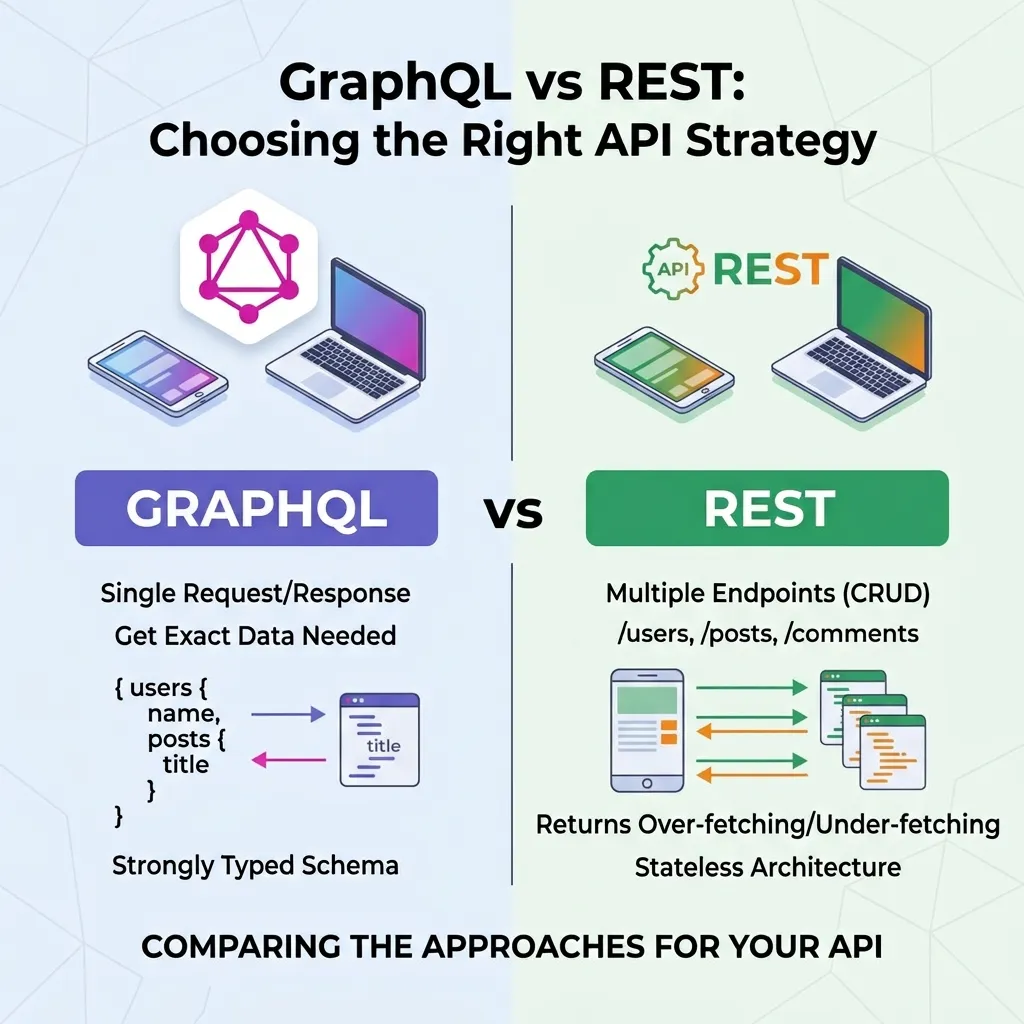
REST, short for Representational State Transfer, is an architectural style built around resources exposed through standard HTTP methods — GET, POST, PUT, DELETE — each operating on a specific URL endpoint. A typical REST API exposes separate endpoints for different resources, such as /users or /orders, with each endpoint returning a fixed, predictable response shape defined by the server.
REST’s biggest strength is its simplicity and ubiquity. It maps naturally onto HTTP itself, works well with standard caching mechanisms, and is understood by virtually every developer and tool in the web ecosystem. Its main limitation shows up when client needs vary significantly — a mobile app that only needs a few fields from a resource still receives the full response the server defines, and a client needing data from multiple resources often has to make several separate requests to assemble what it actually needs.
What Is GraphQL?
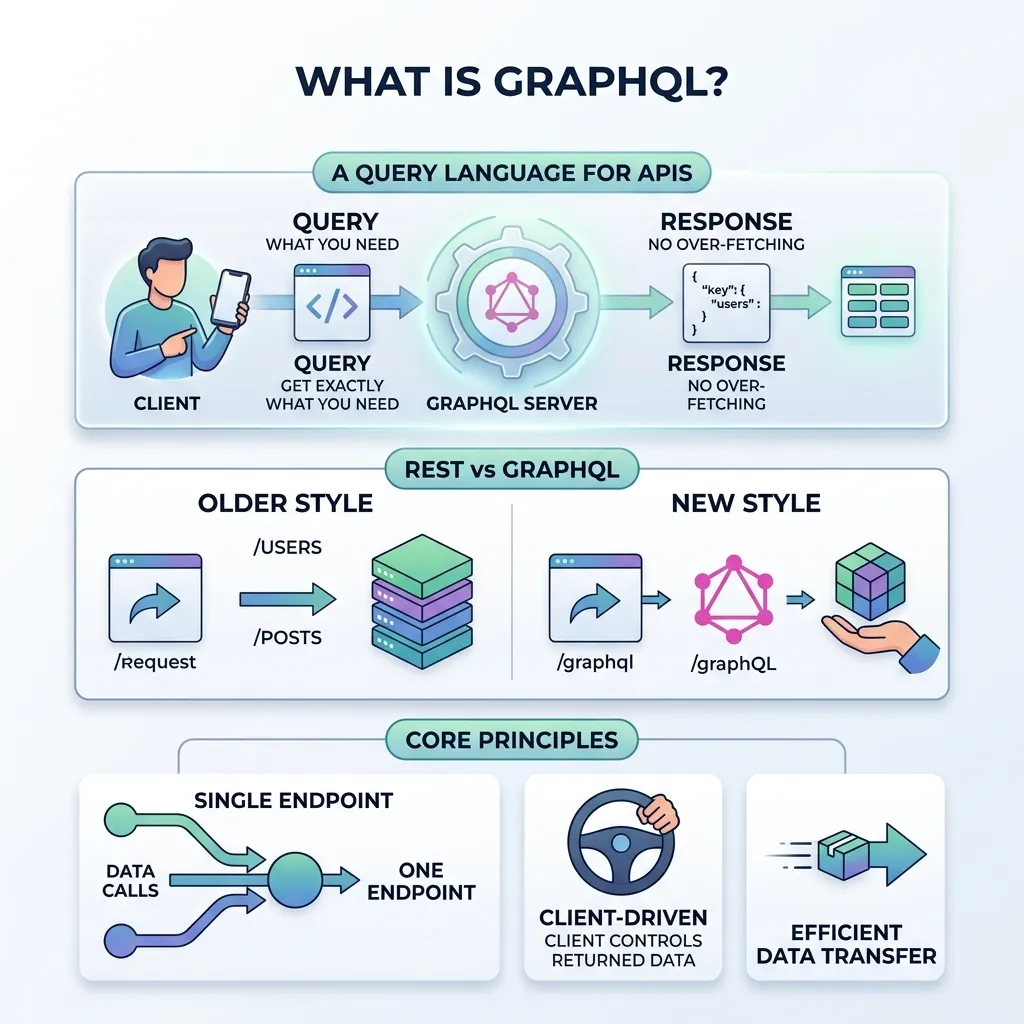
GraphQL is a query language for APIs, originally developed at Facebook and released publicly in 2015, that lets clients specify exactly what data they need in a single request rather than being locked into a fixed response shape per endpoint. Instead of multiple fixed endpoints, a GraphQL API typically exposes a single endpoint backed by a schema that defines the available types and relationships, with resolvers determining how each piece of requested data actually gets fetched.
The core advantage is precision: a client can request exactly the fields it needs, nested across related resources, in one round trip. This solves both over-fetching, where a client receives more data than it needs, and under-fetching, where a client has to make multiple requests to gather related data. The trade-off is added complexity on the server side, since building and maintaining a well-designed schema and resolver layer takes more upfront work than defining a set of REST endpoints.
Key Differences: GraphQL vs REST
Data Fetching and Flexibility
This is the most commonly cited difference. REST’s fixed endpoint responses mean clients often receive either too much data or need multiple requests to gather everything they need. GraphQL’s client-specified queries solve this directly, letting a mobile app request a lean payload while a web dashboard requests a richer one from the exact same underlying schema.
Versioning
REST APIs commonly handle breaking changes through versioning — /v1/users, /v2/users — creating parallel versions of an API as it evolves. GraphQL generally avoids this by allowing fields to be added to a schema without breaking existing queries, and deprecating fields gradually rather than versioning the entire API. This makes long-term schema evolution smoother in GraphQL, though it requires discipline to manage deprecated fields responsibly rather than letting a schema grow unwieldy.
Caching
REST benefits from HTTP’s built-in caching mechanisms, since each endpoint corresponds to a predictable URL that standard HTTP caching layers already understand. GraphQL’s single-endpoint model doesn’t map as naturally onto this caching approach, requiring dedicated client-side caching strategies or specialized tooling to achieve similar performance benefits.
Error Handling
REST APIs typically communicate errors through standard HTTP status codes, which are well understood and easy to handle with generic middleware. GraphQL generally returns a 200 status code regardless of whether part of a query succeeded, embedding error details within the response body instead, which requires clients to inspect the response payload itself rather than relying on the HTTP status alone.
Learning Curve and Tooling
REST’s simplicity means most developers can build a functional API with minimal ramp-up time, and the tooling ecosystem — API documentation generators, testing tools, client libraries — is mature and widely standardized. GraphQL has a steeper initial learning curve, particularly around schema design and resolver architecture, though its tooling ecosystem has matured significantly and includes strong introspection and auto-generated documentation as a natural byproduct of the schema itself.
Where REST Still Wins in the GraphQL vs REST Debate
REST remains the better choice in several common scenarios. Simple APIs with predictable, relatively fixed data needs rarely benefit from GraphQL’s added complexity. Public APIs consumed by a wide range of third-party developers often benefit from REST’s simplicity and the broad familiarity most developers already have with it. And teams without dedicated backend resources to build and maintain a GraphQL schema properly may find REST’s lower operational overhead a better fit for their actual capacity. Our guide to web application architecture covers how API design decisions like this one fit into the broader architectural choices a project has to make.
Where GraphQL Shines in the GraphQL vs REST Debate
GraphQL tends to be the stronger choice when an API serves multiple, meaningfully different client types — a mobile app, a web dashboard, and a third-party integration, for example — each needing a different slice of the same underlying data. It also performs well for applications with deeply nested or highly relational data, where a REST approach would otherwise require multiple round trips to assemble a complete view. Teams building complex, evolving products where the frontend’s data needs shift frequently also benefit from GraphQL’s flexibility, since new client requirements can often be met by adjusting a query rather than requiring backend changes to a fixed endpoint.
Performance Considerations: GraphQL vs REST
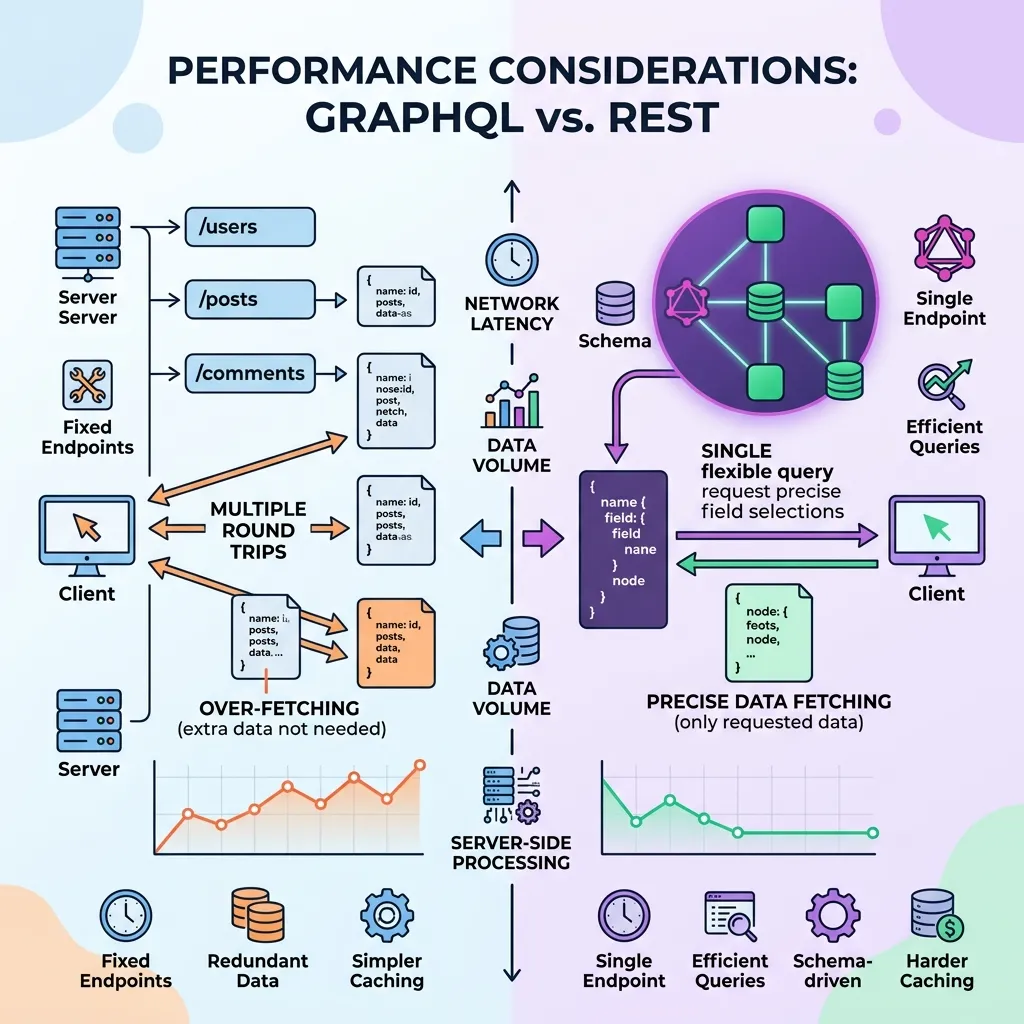
Neither approach is inherently faster than the other — performance depends heavily on implementation quality. REST’s fixed responses can transmit unnecessary data, while GraphQL’s flexibility can introduce its own performance pitfalls, most notably the N+1 query problem, where a naively implemented resolver ends up making a separate database query for each item in a list rather than batching them efficiently. Solving this typically requires dedicated tooling like batching and caching layers built specifically for GraphQL resolvers. Our guide to web application performance covers performance considerations that apply across both API architectures, since good performance ultimately depends more on implementation discipline than on which approach you choose.
Security Considerations: GraphQL vs REST
Both architectures require careful security design, but the specific risks differ. REST’s predictable endpoint structure makes certain protections, like rate limiting per endpoint, relatively straightforward to implement. GraphQL’s flexible query structure introduces different risks — a poorly protected GraphQL API can be vulnerable to overly complex or deeply nested queries that consume excessive server resources, requiring query complexity limits and depth restrictions that REST APIs don’t typically need to think about in the same way. Our guide to web application security covers the broader security fundamentals that apply regardless of which API architecture a project ultimately chooses.
GraphQL vs REST: Can You Use Both?
Many mature systems don’t choose exclusively between GraphQL vs REST — they use both where each makes sense. A common pattern is exposing a GraphQL layer for internal, frequently changing client applications while maintaining REST endpoints for simpler, more stable integrations or public-facing API consumers who expect the industry-standard REST conventions. This hybrid approach lets a team capture GraphQL’s flexibility where it matters most while keeping REST’s simplicity for use cases that don’t need it.
How to Choose the Right API Strategy: GraphQL vs REST
Work through these questions before committing to either approach:
- How many different client types will consume this API? Multiple diverse clients favor GraphQL; a single, predictable client favors REST’s simplicity.
- How relational is your data? Deeply nested, highly related data tends to benefit more from GraphQL’s query flexibility.
- What’s your team’s existing expertise? A team experienced with REST and unfamiliar with GraphQL schema design may see faster, more reliable results sticking with what they know well, at least initially.
- Do you need standard HTTP caching? If caching infrastructure built around REST conventions already exists and works well, switching to GraphQL introduces real caching complexity that needs to be solved separately.
- Is this a public API for third-party developers? REST’s broad familiarity and standardized conventions often make it the safer choice for external developer adoption.
This Kind of Decision Isn’t Unique to APIs
Weighing GraphQL vs REST carefully is a specific case of a broader pattern every technical team runs into: choosing between a more flexible, more complex option and a simpler, more standardized one. The same tension shows up constantly in other technology decisions. Ecompromotion’s comparison of business intelligence versus data analytics walks through a similar kind of trade-off in a completely different domain — neither option is universally correct, and the right choice depends on the specific problem a team is actually trying to solve rather than which approach carries more industry buzz.
The same logic extends to picking any platform or tool that will underpin how a team builds and ships work. Vidpromot’s guide to choosing the right video marketing platform makes a parallel point from a marketing context: matching a tool to your team’s actual workflow and resources produces better outcomes than defaulting to whichever option is most talked about. Whether the decision is GraphQL vs REST, one analytics approach versus another, or any other foundational technology choice, the discipline of evaluating fit over hype tends to produce the most durable results.
How Team Size and Project Stage Should Influence the Decision
A five-person startup building an MVP with a single web client rarely needs GraphQL’s added complexity, even if the product might eventually grow into something with more diverse client needs. Starting simple with REST and migrating specific parts of the API to GraphQL later, once genuine multi-client complexity actually materializes, is often a more pragmatic path than building GraphQL infrastructure speculatively before it’s needed.
Conversely, a team already supporting multiple client applications — a web app, a native mobile app, and a partner integration, for example — often finds that the upfront cost of building a GraphQL schema pays for itself quickly, since it replaces what would otherwise be several parallel REST endpoint variations built to serve each client’s slightly different needs. Recognizing which situation actually describes your project, rather than defaulting to whichever architecture is more commonly discussed in current development conversations, is the real skill in this decision.
Common Mistakes When Choosing Between GraphQL and REST
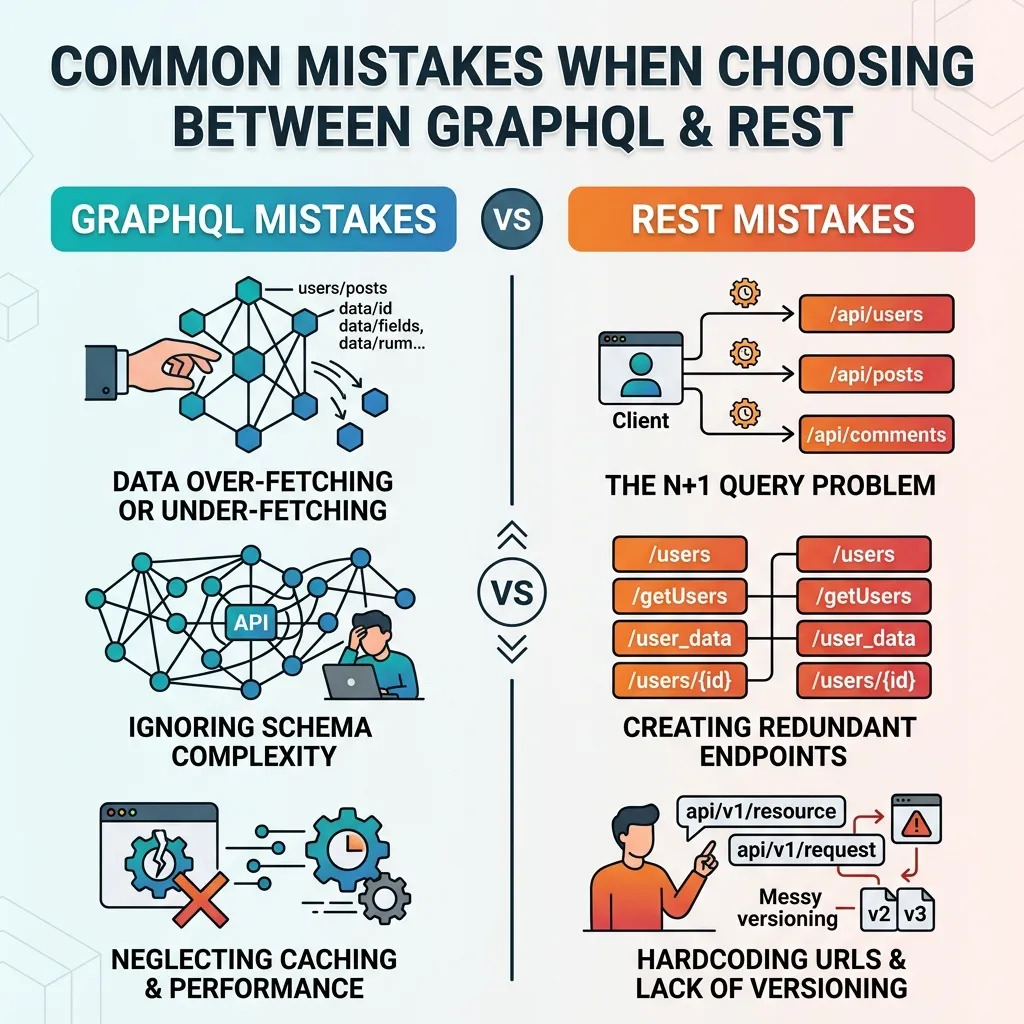
- Choosing GraphQL because it’s trendy rather than because it fits the use case. Added complexity without a genuine flexibility need is a net loss, not a modernization win.
- Underestimating the N+1 query problem in GraphQL. Skipping proper batching and caching leads to serious, hard-to-diagnose performance issues as an API scales.
- Sticking with REST purely out of habit for a genuinely multi-client, deeply relational API. This forces client-side workarounds that a GraphQL layer would have handled naturally.
- Ignoring query complexity limits in GraphQL. Without depth and complexity restrictions, a GraphQL API is exposed to resource-exhaustion risks that REST’s fixed endpoints don’t share.
- Treating the decision as permanent and irreversible. Many systems evolve to use both approaches, and starting with one doesn’t preclude adopting the other where it later makes sense.
Conclusion
GraphQL vs REST isn’t a question with a universally correct answer — it’s a decision that depends on how many client types your API serves, how relational your data is, your team’s existing expertise, and whether standard HTTP caching matters for your use case. REST remains an excellent default for simpler, more predictable APIs and public-facing integrations, while GraphQL earns its added complexity when multiple diverse clients need flexible, precise access to deeply related data. Many mature systems ultimately use both, choosing the right tool for each specific part of their API surface rather than treating the decision as an all-or-nothing commitment. Evaluate your actual requirements honestly, and choose the architecture that matches the shape of your data and the needs of the clients consuming it.
Frequently Asked Questions About GraphQL vs REST
In the GraphQL vs REST Debate, Is GraphQL Simply Better?
Neither is universally better — GraphQL offers more flexibility for complex, multi-client APIs, while REST offers simplicity and broad familiarity that works well for simpler or public-facing APIs.
What Is the Main Advantage of GraphQL Over REST?
GraphQL lets clients request exactly the data they need in a single query, solving the over-fetching and under-fetching problems common with REST’s fixed endpoint responses.
Is REST Easier to Learn Than GraphQL?
Generally yes. REST maps directly onto standard HTTP methods that most developers already understand, while GraphQL requires learning schema design and resolver architecture.
Does GraphQL Replace REST Entirely?
No. Many systems use both, exposing GraphQL for flexible, multi-client needs while keeping REST for simpler or public-facing integrations where its conventions are expected.
Is GraphQL Faster Than REST?
Not inherently. Performance depends on implementation quality in both cases, and a poorly implemented GraphQL API can suffer from the N+1 query problem if not properly optimized.
Can I Cache GraphQL Responses Like REST Responses?
Not as easily using standard HTTP caching, since GraphQL typically uses a single endpoint; achieving similar caching benefits requires dedicated client-side or specialized caching tools.
Is GraphQL Harder to Secure Than REST?
It introduces different security considerations, particularly around query complexity and depth, which require dedicated limits that REST’s fixed endpoints don’t typically need.
When Should I Choose REST Over GraphQL?
REST is generally the better choice for simple, predictable APIs, public APIs for third-party developers, and teams without the resources to build and maintain a GraphQL schema properly.
When Should I Choose GraphQL Over REST?
GraphQL fits best when an API serves multiple different client types with varying data needs, or when your data is deeply relational and REST would otherwise require many round trips.
How Does Versioning Differ Between GraphQL and REST?
REST commonly uses explicit versioned endpoints for breaking changes, while GraphQL typically evolves a single schema by adding fields and gradually deprecating old ones.
Do I Need Special Tools to Build a GraphQL API?
Most teams use a GraphQL server library suited to their backend language, along with tooling for schema management, query batching, and complexity limiting to avoid common performance and security pitfalls.
Can a Small Project Benefit From GraphQL, or Is It Only for Large Systems?
GraphQL can benefit smaller projects with genuinely diverse client needs, but for a simple project with one predictable client, REST’s lower complexity is usually the more practical choice.