Website optimization services improve your site’s speed, SEO, user experience, mobile performance, and conversion rates to help attract more visitors and turn them into customers. By continuously optimizing your website, businesses can achieve higher search rankings, faster load times, better user engagement, and increased revenue.
Website optimization services cover everything from speed improvements and technical fixes to SEO, UX design, and conversion rate optimization. Businesses that invest in these services typically see faster load times, higher search rankings, and more conversions—making optimization one of the highest-ROI digital investments available.
Your website might be costing you more than you think. Not in hosting fees or maintenance costs, but in lost visitors, missed conversions, and search rankings you never reach. A slow, poorly structured, or hard-to-navigate site quietly erodes trust, drives users away, and hands business to your competitors—often before a single word is read.
Website optimization services address all of this. They cover the full spectrum of improvements needed to make a site perform at its best: from the technical infrastructure running under the hood to the on-page experience that shapes whether a visitor stays or bounces. For businesses serious about digital growth, optimization isn’t a one-time task—it’s an ongoing strategy.
This guide breaks down every major category of website optimization, explains what each one involves, and helps you understand which services matter most for your goals. By the end, you’ll have a clear picture of what a well-optimized website looks like—and how to get yours there.
What Is Website Performance Optimization?
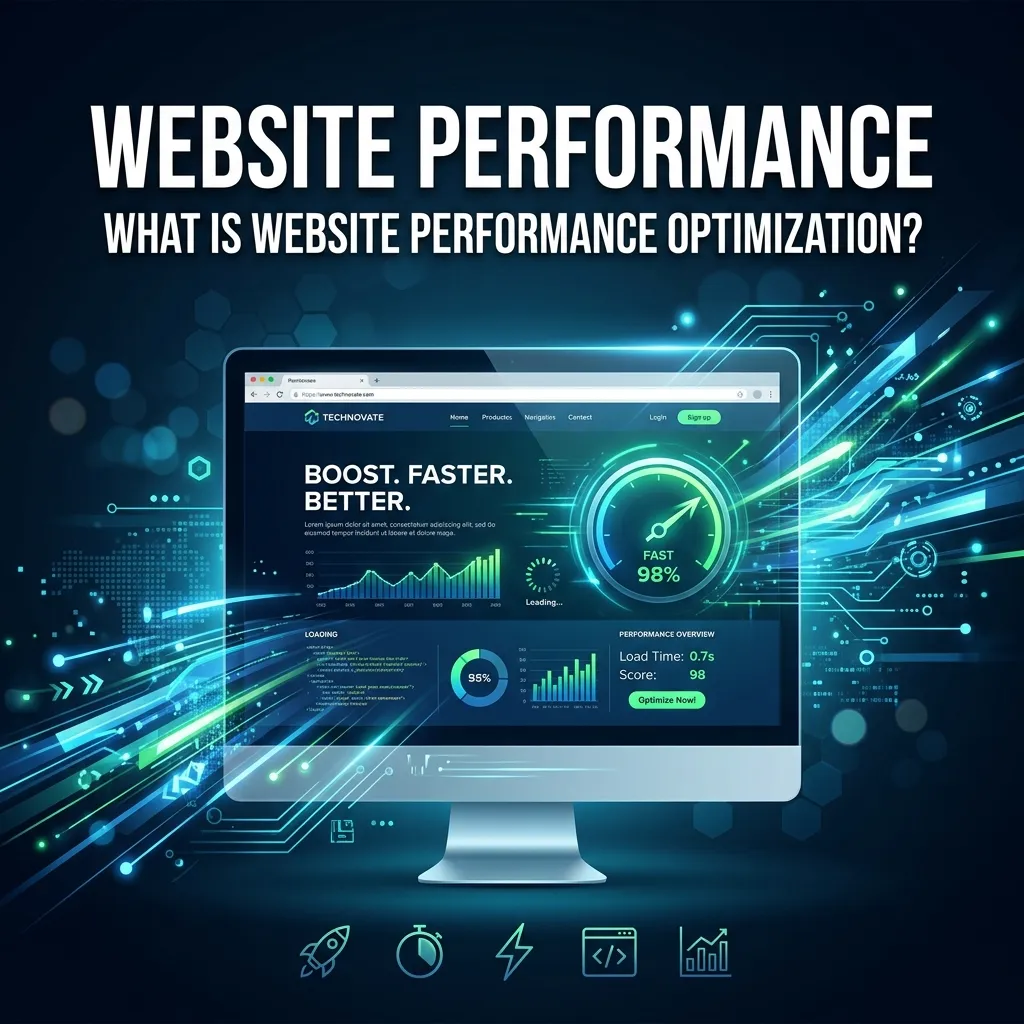
Website performance optimization is the process of improving how efficiently a site loads and functions for its users. It encompasses everything from server response times and image compression to code efficiency and caching strategies. For a deeper dive into practical optimization methods, explore our guide on web performance optimization techniques, which covers proven strategies for improving load times and Core Web Vitals.
Performance directly influences user behavior. According to Google, the probability of a bounce increases by 32% when page load time goes from one second to three seconds. At five seconds, that figure jumps to 90%. These aren’t marginal differences—they represent a significant portion of potential customers walking away before engaging with your content.
Performance optimization typically involves:
- Reducing file sizes through image compression and minification of CSS, JavaScript, and HTML
- Leveraging browser caching to reduce the load placed on servers for returning visitors
- Optimizing server response times by improving hosting infrastructure or using content delivery networks (CDNs)
- Eliminating render-blocking resources that delay how quickly a browser can display your page
A well-optimized site doesn’t just feel faster—it scores better on Google’s Core Web Vitals, which are now a confirmed ranking factor in Google Search.
Website Speed Optimization Services: What Do They Include?
Speed optimization is often the most urgent area businesses address, and for good reason. A one-second delay in page response can result in a 7% reduction in conversions, according to research cited by Akamai.
Professional website speed optimization services typically audit your site using tools like Google PageSpeed Insights, GTmetrix, or Lighthouse. These tools measure key metrics including:
- Largest Contentful Paint (LCP): How long it takes for the main content to load
- First Input Delay (FID): How quickly the page responds to user interaction
- Cumulative Layout Shift (CLS): How visually stable the page is during load
From there, a provider will implement targeted fixes—optimizing images, deferring non-critical JavaScript, enabling lazy loading, upgrading hosting environments, or switching to faster DNS providers. Each change is measured against baseline performance to quantify improvement. Since hosting plays a major role in loading speed, it’s also worth learning how web hosting affects website speed and performance before making infrastructure decisions.
SEO Website Optimization: Ranking Higher in Search
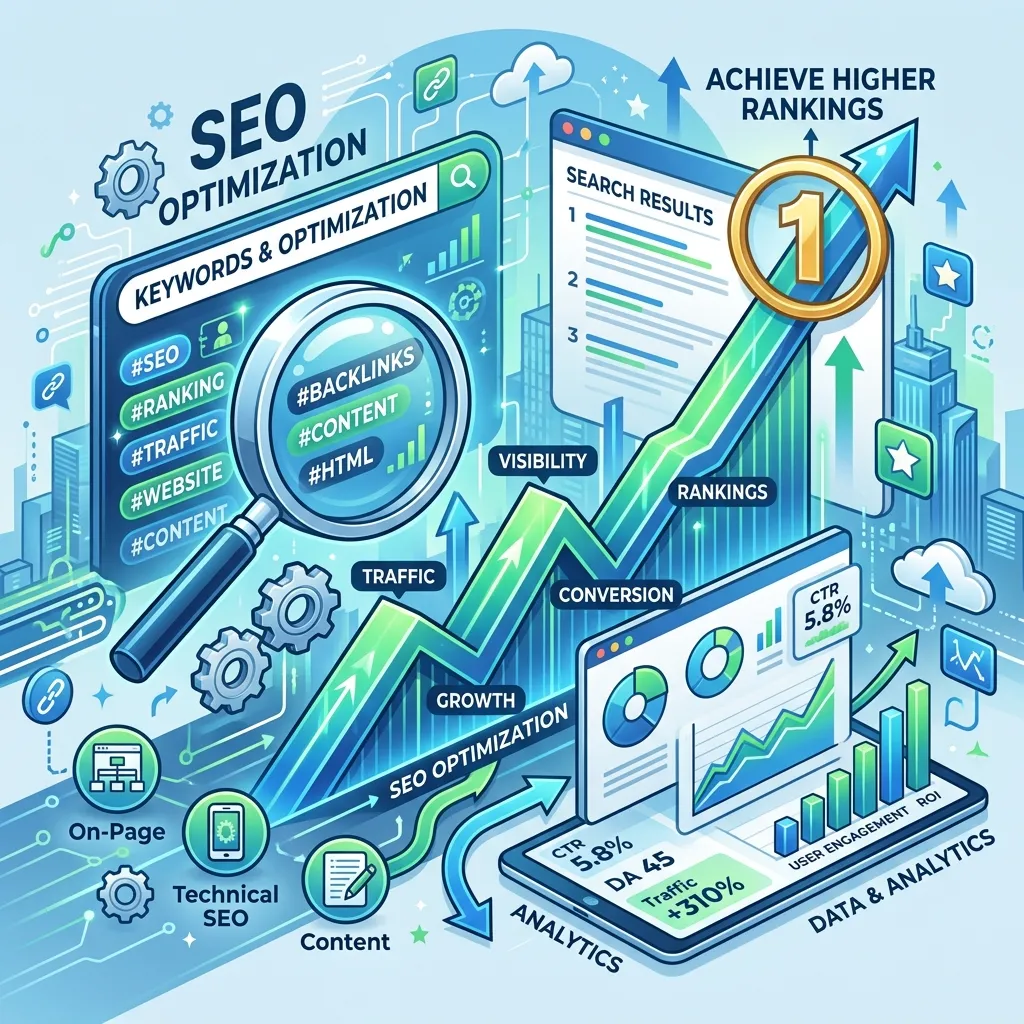
Search engine optimization (SEO) and website optimization are deeply intertwined. A technically sound, fast-loading, well-structured website is far easier for search engines to crawl and index—making technical SEO a core component of any optimization strategy.
SEO website optimization services generally cover:
On-Page SEO
This includes optimizing title tags, meta descriptions, header structures, internal linking, and keyword placement. On-page SEO ensures that each page clearly communicates its topic to both users and search engines.
Technical SEO
Technical issues are often invisible to casual users but have outsized effects on both SEO performance and site reliability. Regular technical audits—conducted at least quarterly—help catch problems before they escalate. Security should also be part of every optimization strategy, so it’s worth reviewing these web application security best practices
Content Optimization
Search engines reward content that comprehensively answers user queries. Optimization here involves identifying content gaps, improving existing pages, targeting relevant keywords, and ensuring content aligns with search intent—not just keyword frequency.
According to HubSpot’s 2023 State of Marketing Report, companies that blog regularly generate 55% more website visitors than those that don’t. Pairing consistent content creation with sound optimization amplifies that traffic significantly.
Website Conversion Optimization: Turning Visitors Into Customers

Traffic means nothing without conversions. Website conversion optimization—also known as conversion rate optimization (CRO)—focuses on improving the percentage of visitors who complete a desired action, whether that’s making a purchase, submitting a form, or signing up for a newsletter.
CRO services combine data analysis with behavioral insights. Common techniques include A/B testing headlines, calls-to-action, page layouts, and color schemes to identify what performs best. The same optimization mindset also applies to A/B testing for email marketing, helping businesses improve click-through rates and conversions across multiple channels.
CRO services combine data analysis with behavioral insights. Common techniques include:
- A/B testing headlines, calls-to-action, page layouts, and color schemes to identify what performs best
- Heatmap and session recording analysis to understand where users click, scroll, and drop off
- Landing page optimization to align messaging with user intent and reduce friction
- Form optimization to minimize the number of fields and reduce abandonment rates
A structured CRO program can deliver significant returns. According to research by Econsultancy, for every $92 businesses spend acquiring customers, only $1 is spent converting them—highlighting a substantial opportunity that many businesses overlook.
Technical Website Optimization: The Foundation Everything Rests On
Behind every high-performing website is a solid technical foundation. Technical optimization services address the structural elements that affect how well a site is built, maintained, and scaled.
Key areas include:
- Fixing broken links and 404 errors that frustrate users and waste crawl budget
- Implementing proper redirect chains to preserve link equity during site migrations or URL changes
- Optimizing site architecture to ensure logical page hierarchies and clean internal linking
- Database optimization for dynamic sites that rely on CMS platforms like WordPress
- Security hardening through SSL certificates, two-factor authentication, and malware scanning
Technical issues are often invisible to casual users but have outsized effects on both SEO performance and site reliability. Regular technical audits—conducted at least quarterly—help catch problems before they escalate.
Website User Experience Optimization: Designing for Real People
User experience (UX) optimization bridges the gap between functionality and usability. A site can be technically sound and still lose visitors because it’s confusing, visually cluttered, or difficult to navigate.
UX optimization services focus on:
- Information architecture: Structuring content so users can find what they need quickly and intuitively
- Navigation design: Simplifying menus, reducing the number of clicks to key pages, and improving breadcrumb trails
- Readability and visual hierarchy: Using typography, whitespace, and contrast to guide users through content
- Accessibility compliance: Meeting WCAG (Web Content Accessibility Guidelines) standards to ensure the site is usable by people with disabilities
The business case for UX investment is strong. According to Forrester Research, every $1 invested in UX delivers a return of $100—a 9,900% ROI. That figure reflects reduced support costs, higher conversion rates, and improved customer retention.
Mobile Website Optimization: Meeting Users Where They Are
Mobile devices now account for approximately 58% of global web traffic, according to Statista (2023). A site that performs well on desktop but struggles on mobile is effectively alienating the majority of its potential audience.
Mobile optimization services address:
- Responsive design: Ensuring layouts adapt seamlessly across screen sizes
- Touch-friendly interfaces: Designing buttons, forms, and navigation for finger input rather than mouse clicks
- Mobile page speed: Mobile networks are often slower than broadband, making speed optimization even more critical on small-screen devices
- Viewport configuration: Ensuring content scales correctly across different device types
Google’s mobile-first indexing—now the default for all websites—means Google primarily uses the mobile version of a site for indexing and ranking. A subpar mobile experience doesn’t just cost users; it costs rankings.
How to Choose a Website Optimization Company
Not all website optimization providers offer the same level of service, expertise, or transparency. When evaluating potential partners, consider the following:
Look for a data-driven approach. A credible optimization company will audit your site before recommending any work, benchmark current performance, and report on measurable outcomes. Be cautious of providers who offer generic packages without assessing your specific situation.
Check for cross-functional expertise. Effective optimization requires skills across technical development, SEO, UX design, and analytics. A team with specialists in each area will deliver more comprehensive results than a generalist agency.
Ask about reporting and communication. Ongoing optimization requires continuous measurement. Look for partners who provide regular performance reports and explain results in plain language.
Review case studies and references. Past performance is a strong indicator of future results. Ask for examples of similar projects and quantified outcomes wherever possible.
Website Optimization Solutions: Choosing the Right Mix for Your Goals
The right combination of website optimization solutions depends on where your biggest gaps lie. A fast site with poor SEO needs different attention than a well-ranked site with a low conversion rate. Prioritization matters.
A useful framework for deciding where to start:
- If your traffic is low, prioritize SEO optimization and content improvements
- If traffic is high but conversions are low, focus on CRO and UX optimization
- If users are bouncing quickly, address speed, mobile usability, and content clarity
- If rankings have dropped, investigate technical SEO issues and Core Web Vitals performance
Most businesses benefit from addressing multiple areas simultaneously, but understanding which levers have the greatest impact on your specific goals helps allocate budget and effort effectively.
Website Optimization for Search Engines: Staying Ahead of Algorithm Changes
Search engine algorithms evolve constantly. Google alone makes thousands of updates each year, ranging from minor adjustments to major core algorithm shifts. Website optimization for search engines requires an ongoing commitment—not a set-and-forget approach.
Key long-term strategies include:
- Monitoring Core Web Vitals performance and addressing regressions promptly
- Keeping content updated and relevant to shifting search intent
- Building high-quality backlinks through authoritative content and digital PR
- Monitoring Google Search Console for crawl errors, indexing issues, and manual actions
Staying ahead of algorithm updates isn’t about gaming the system—it’s about building a site that genuinely serves users well. Sites that prioritize quality, performance, and relevance tend to weather algorithm changes far better than those optimized for shortcuts.
A Faster, Higher-Ranking, Better-Converting Website Starts Here
Website optimization isn’t a single project with a finish line. It’s a continuous process of measurement, improvement, and adaptation—one that compounds over time as your site becomes faster, more visible, and more effective at converting the traffic it earns.
The good news? Every improvement compounds. A faster site gets more search visibility. Better rankings bring more traffic. Improved UX and CRO turn more of that traffic into customers. Each area reinforces the others.
If your site isn’t performing the way you’d like, start with a comprehensive audit to identify your highest-priority opportunities. Whether you work with a professional website optimization company or build in-house capability, the principles remain the same: measure, optimize, test, and repeat.
Frequently Asked Questions
What are website optimization services?
Website optimization services are professional services designed to improve a website’s performance, search engine visibility, user experience, and conversion rates. They typically include technical SEO, speed optimization, mobile optimization, UX improvements, and conversion rate optimization.
How long does it take to see results from website optimization?
Results vary depending on the type of optimization. Speed improvements are often visible within days. SEO changes typically take three to six months to reflect in search rankings. Conversion rate improvements from A/B testing can surface within weeks, depending on traffic volume.
How much do website optimization services cost?
Costs vary widely based on scope and provider. Basic audits may start at a few hundred dollars, while comprehensive ongoing optimization programs can range from $1,000 to $10,000+ per month. Most providers offer tiered packages based on site size and complexity.
Do I need ongoing optimization or is a one-time fix enough?
Most businesses benefit from ongoing optimization. Search engine algorithms change, user behavior evolves, and new competitors enter the market. Treating optimization as a continuous process—rather than a one-time project—delivers better long-term results.
What’s the difference between SEO and website optimization?
SEO (search engine optimization) is a subset of website optimization focused specifically on improving search engine rankings. Website optimization is a broader term that also includes speed improvements, UX design, conversion rate optimization, technical health, and mobile performance.
Can website optimization help with mobile traffic?
Yes. Mobile optimization is a core component of comprehensive website optimization services. Given that mobile devices account for the majority of global web traffic, ensuring your site performs well on small screens is essential for both user experience and search