

Web application development frameworks provide developers with the tools, structures, libraries, and conventions needed to build modern web applications faster and more efficiently. Instead of creating every feature from scratch, developers can use frameworks to handle common requirements such as routing, authentication, database communication, API integration, security, testing, and user interface development.
Choosing the right web application development framework can significantly affect development speed, scalability, performance, security, maintenance, and long-term project costs. However, there is no single framework that is perfect for every application.
A startup building a simple SaaS product may have different requirements from an enterprise developing a large-scale financial platform. Similarly, a developer creating a content-driven application may choose a different technology stack than someone building a real-time collaboration platform.
This guide explains the major types of web application development frameworks, popular framework options, their advantages and disadvantages, and how to choose the right framework for your project.
What Are Web Application Development Frameworks?
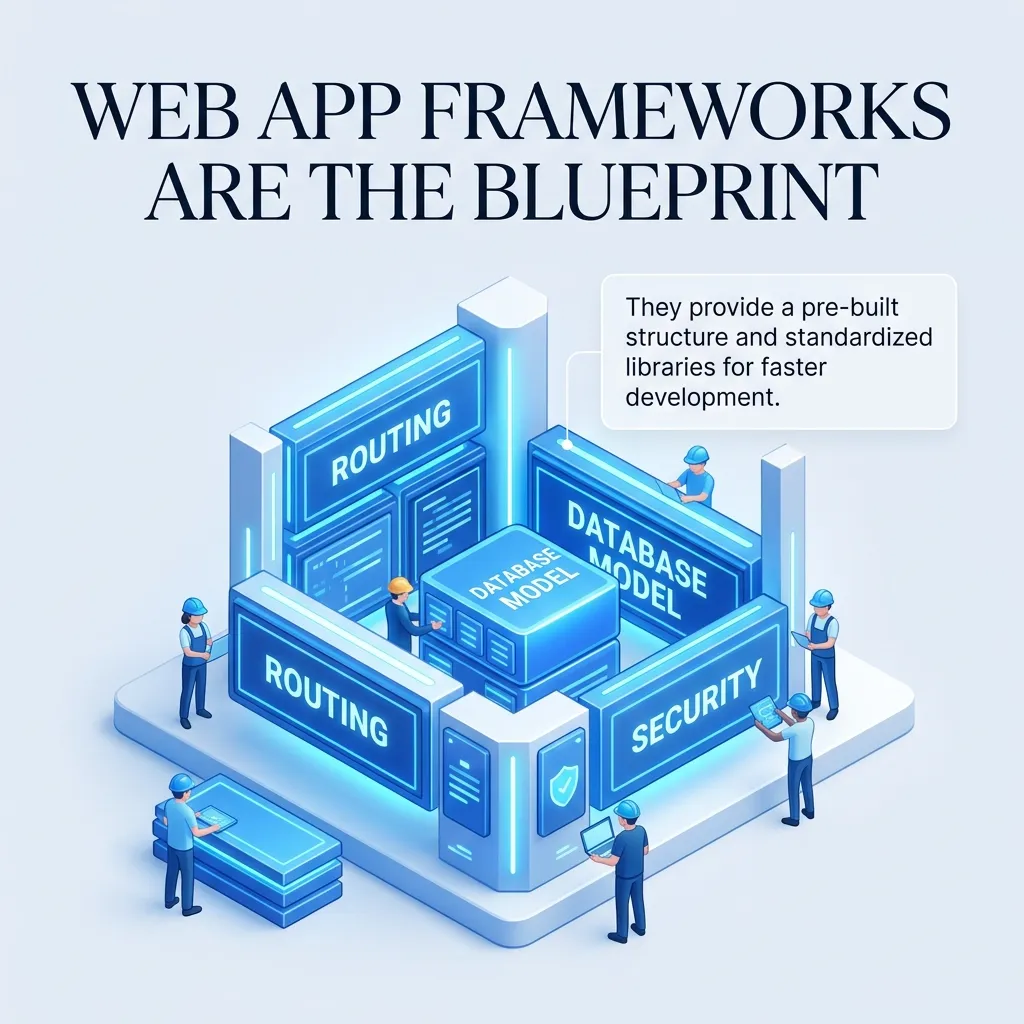
Web application development frameworks are pre-built software structures that help developers create web applications using standardized tools, libraries, components, and development patterns.
Instead of manually building fundamental functionality, developers can rely on framework features for common development tasks.
For example, a framework may provide built-in support for:
- URL routing
- Database operations
- Authentication
- API development
- Form handling
- Session management
- Security features
- Error handling
- Testing
- Frontend components
- Application configuration
This makes development more organized and can reduce repetitive coding.
For a broader understanding of how applications are structured, see the site’s guide to web application architecture.
How Do Web Development Frameworks Work?
A framework provides a predefined structure within which developers build an application.
The developer writes application-specific code while the framework handles many repetitive or infrastructure-level tasks.
For example, when a user visits a URL, the framework can:
- Receive the request.
- Identify the appropriate route.
- Process authentication or permissions.
- Execute application logic.
- Retrieve information from a database or API.
- Generate a response.
- Return the response to the browser.
This structured approach helps development teams maintain consistency across large projects.
Why Are Frameworks Used in Web Application Development?
Frameworks are primarily used to improve productivity, consistency, maintainability, and scalability.
They allow developers to focus more on business functionality instead of repeatedly solving common technical problems.
Frameworks can also establish conventions that make it easier for multiple developers to collaborate on the same application.
Frameworks vs Libraries
A library provides reusable functionality that developers can call when needed.
A framework usually provides a broader application structure and controls more of the development flow.
In simple terms:
| Library | Framework |
|---|---|
| Developer controls the flow | Framework provides application structure |
| Usually focused on specific functionality | Usually covers broader development needs |
| Can be added to an existing project | Often influences project architecture |
| More flexible in some situations | More opinionated in many cases |
The distinction can vary depending on the technology, but the difference in control and application structure is an important concept.
Types of Web Application Development Frameworks
Web application development frameworks can be categorized according to the part of the application they primarily support.
The two broad categories are frontend frameworks and backend frameworks. There are also full-stack frameworks that combine capabilities across both layers.
Frontend Frameworks
Frontend frameworks help developers build the user-facing portion of web applications.
They are commonly used to create:
- Interactive interfaces
- Dynamic pages
- Reusable UI components
- Client-side navigation
- Form interactions
- Real-time interface updates
Popular technologies in this category include React-based frameworks, Angular, and Vue.
If you want a basic explanation of React before exploring larger framework ecosystems, check the site’s React beginner’s guide.
Backend Frameworks
Backend frameworks operate primarily on the server side.
They help developers manage:
- Business logic
- Databases
- Authentication
- APIs
- Server-side rendering
- Security
- Data processing
- Application infrastructure
Popular backend ecosystems include Django, Laravel, Ruby on Rails, Spring Boot, Express, and ASP.NET Core.
Full-Stack Frameworks
Full-stack frameworks provide tools for developing both frontend and backend functionality within a unified ecosystem.
They can simplify development by allowing teams to manage routing, data fetching, rendering, APIs, and application logic within a connected architecture.
Examples include:
- Next.js
- Nuxt
- SvelteKit
- Laravel with frontend integrations
- Django-based full-stack applications
- ASP.NET Core applications
Full-stack frameworks can be especially useful for teams that want an integrated development experience.
Microservices and Specialized Frameworks
Some applications use specialized frameworks within a larger distributed architecture.
For example, a company might use different technologies for:
- Authentication services
- Payment services
- Product APIs
- Real-time communication
- Data processing
- Customer dashboards
The framework decision should therefore consider the overall architecture rather than focusing on a single application layer.
Popular Web Application Development Frameworks
Different frameworks solve different development problems. The best choice depends on project requirements, team expertise, performance expectations, and long-term maintenance needs.
React and React-Based Frameworks
React is widely used for building interactive user interfaces with reusable components.
React itself is primarily a UI library, while frameworks built around React provide additional capabilities such as routing, server-side rendering, data fetching, and application structure.
React-based frameworks can be useful for:
- SaaS applications
- E-commerce platforms
- Dashboards
- Content platforms
- Interactive web applications
For projects requiring a broader React-based application architecture, frameworks such as Next.js can provide additional functionality.
Angular
Angular is a comprehensive frontend framework maintained by Google.
It provides a structured approach to building large-scale applications and includes features for:
- Components
- Routing
- Forms
- Dependency injection
- HTTP communication
- Testing
- Application organization
Angular is often attractive to enterprise development teams that prefer a strongly structured framework.
Vue
Vue is a progressive JavaScript framework designed for building user interfaces.
It is known for its approachable learning curve and component-based architecture.
Vue can be used for:
- Small interactive features
- Single-page applications
- Dashboards
- E-commerce interfaces
- Large applications when paired with an appropriate ecosystem
Its flexibility makes it suitable for teams that want a gradual adoption strategy.
Django
Django is a Python-based web framework designed for rapid and secure application development.
It follows a batteries-included philosophy and provides many features out of the box.
Django is commonly used for:
- Data-driven applications
- Content management systems
- Business platforms
- SaaS applications
- Backend-heavy systems
Developers who already work extensively with Python may find Django particularly attractive.
Laravel
Laravel is a PHP framework designed to simplify modern web application development.
It includes tools for:
- Routing
- Authentication
- Database operations
- Queues
- Caching
- Validation
- API development
- Application testing
Laravel is particularly popular among developers working within the PHP ecosystem.
Node.js and Express
Node.js allows JavaScript to run on the server, while Express provides a lightweight framework for building web applications and APIs.
This combination can be useful when teams want JavaScript across both frontend and backend development.
Common use cases include:
- REST APIs
- Real-time applications
- SaaS platforms
- Backend services
- Microservices
Ruby on Rails
Ruby on Rails is a full-stack web framework based on Ruby.
It emphasizes developer productivity, conventions, and rapid application development.
Rails can be useful for:
- Startups
- SaaS products
- Business applications
- Database-driven platforms
Its convention-over-configuration approach reduces the amount of configuration developers need to perform manually.
Spring Boot
Spring Boot is widely used for Java-based backend application development.
It simplifies the creation of production-ready applications within the Spring ecosystem.
Spring Boot is often selected for:
- Enterprise applications
- Financial systems
- Large backend services
- Microservices
- High-complexity business applications
ASP.NET Core
ASP.NET Core is Microsoft’s cross-platform framework for building modern web applications and APIs.
It supports development using C# and integrates closely with the broader .NET ecosystem.
It can be suitable for:
- Enterprise applications
- APIs
- Cloud-based services
- Business applications
- High-performance backend systems
Web Application Framework Comparison
Choosing between frameworks becomes easier when their general characteristics are compared.
| Framework | Primary Ecosystem | Best Known For | Typical Use |
|---|---|---|---|
| React | JavaScript/TypeScript | UI development | Interactive applications |
| Angular | TypeScript | Structured frontend development | Enterprise applications |
| Vue | JavaScript/TypeScript | Flexible UI development | SPAs and interfaces |
| Django | Python | Full-featured backend development | Data-driven applications |
| Laravel | PHP | Developer-friendly backend development | Business and web applications |
| Express | JavaScript/TypeScript | Lightweight server development | APIs and services |
| Ruby on Rails | Ruby | Rapid development | SaaS and startups |
| Spring Boot | Java | Enterprise backend systems | Large-scale applications |
| ASP.NET Core | C#/.NET | Enterprise and cloud applications | APIs and business systems |
| Next.js | JavaScript/TypeScript | React-based full-stack development | Modern web applications |
The table is a starting point rather than a universal ranking. Project requirements should determine the final choice.
Benefits of Using Web Application Development Frameworks
Frameworks provide several advantages compared with building every application component from scratch.
Faster Development
Frameworks provide reusable components and established patterns.
Developers do not need to reinvent solutions for every common requirement. This can shorten development cycles and help teams release features more quickly.
For example, routing, authentication, database access, validation, and API handling can often be implemented using existing framework functionality.
Better Code Organization
A framework typically encourages developers to organize files, components, services, controllers, models, and other application elements consistently.
This makes large applications easier to understand and maintain.
Improved Security
Many established frameworks provide security features or recommended patterns for common vulnerabilities.
Depending on the framework, developers may receive built-in or ecosystem-supported protection against issues involving:
- Cross-site scripting
- Cross-site request forgery
- SQL injection
- Authentication problems
- Input validation
- Session management
Framework security features still require proper configuration and responsible development.
Scalability
Frameworks can provide patterns that support applications as they grow.
However, scalability does not come automatically from selecting a particular framework. Database design, caching, infrastructure, architecture, APIs, code quality, and deployment strategy also matter.
For a broader look at application performance, explore website performance optimization for marketers.
Easier Team Collaboration
A common framework gives developers shared conventions.
When everyone follows the same architecture and coding patterns, new developers can understand the project more quickly.
This becomes especially important for large development teams.
Access to Developer Ecosystems
Popular frameworks typically have large ecosystems of:
- Documentation
- Packages
- Plugins
- Tutorials
- Development tools
- Testing solutions
- Community support
This ecosystem can significantly reduce the time required to solve common development challenges.
How to Choose the Right Web Application Development Framework
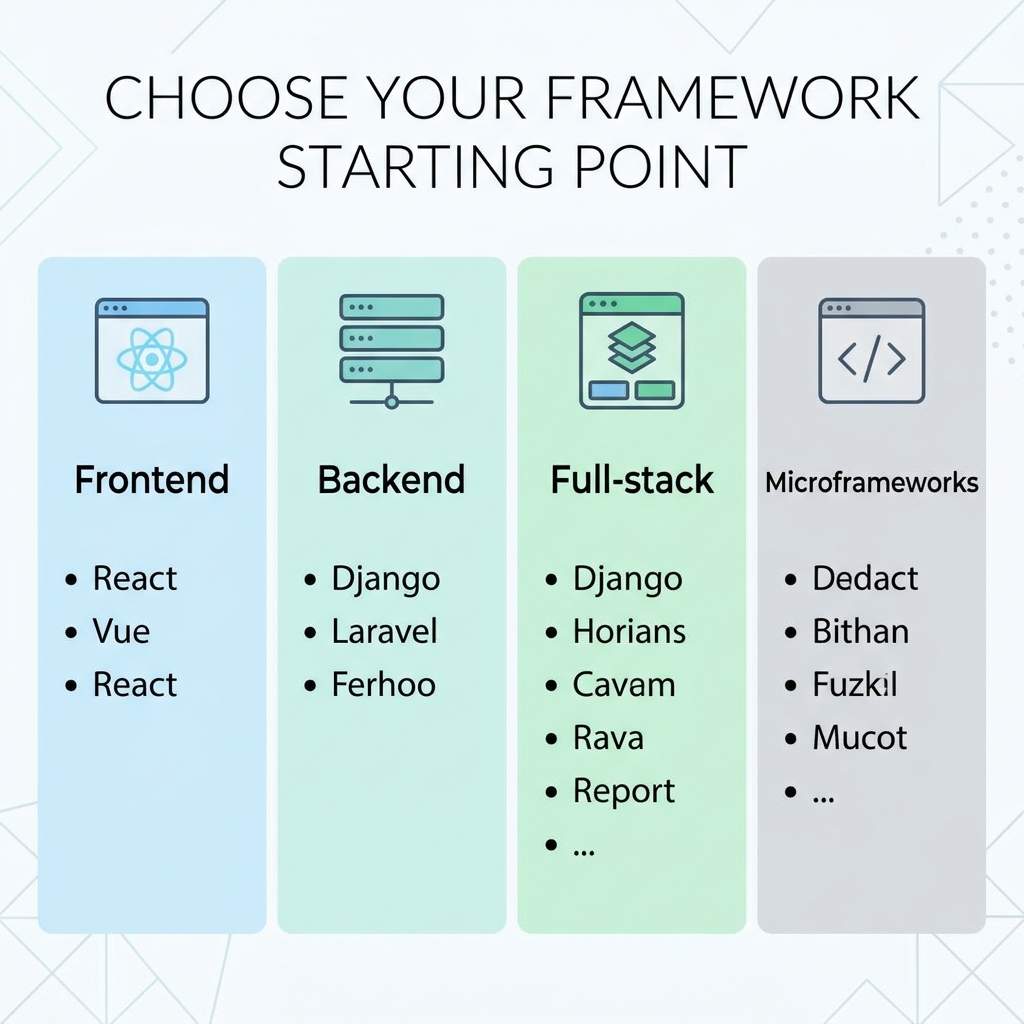
Selecting a framework should begin with the application’s requirements rather than the framework’s popularity.
Define Project Requirements
Start by identifying:
- Application type
- Target users
- Expected traffic
- Required features
- Data requirements
- Security requirements
- Integration requirements
- Performance expectations
- Budget
- Development timeline
A simple application does not necessarily require the same technology stack as an enterprise platform.
Evaluate Team Expertise
Your development team’s existing skills are extremely important.
For example, a team experienced in Python may be more productive with Django, while a JavaScript-focused team may prefer a JavaScript or TypeScript ecosystem.
A technically impressive framework can still be a poor choice if the team lacks the expertise to maintain it.
Consider Performance Requirements
Performance requirements vary significantly between projects.
Consider:
- Initial load performance
- Server response time
- Database performance
- Rendering strategy
- API latency
- Caching requirements
- Concurrent users
Framework selection should support these requirements without introducing unnecessary complexity.
Consider Scalability
Think about how the application may evolve over the next several years.
Ask:
- Will traffic increase significantly?
- Will the application need additional services?
- Will multiple development teams work on it?
- Will the database become large?
- Will international users access it?
- Will real-time functionality be required?
The right framework should fit both current and future requirements.
Framework Selection Based on Project Type
Different applications often benefit from different development approaches.
SaaS Applications
SaaS platforms typically require:
- User authentication
- Subscription management
- Dashboards
- APIs
- Database integration
- Notifications
- Analytics
Frameworks such as Django, Laravel, Rails, Next.js, and ASP.NET Core can be suitable depending on the team’s expertise and application architecture.
E-Commerce Applications
E-commerce platforms need reliable:
- Product catalogs
- Search
- Shopping carts
- Payment integrations
- User accounts
- Order management
- Security
- Performance
The framework should support both technical requirements and future scaling.
For broader e-commerce development context, the site also covers ecommerce web development.
Enterprise Applications
Enterprise applications usually prioritize:
- Security
- Maintainability
- Scalability
- Integration
- Testing
- Team collaboration
- Long-term support
Structured ecosystems such as Angular, Spring Boot, and ASP.NET Core can be strong choices depending on organizational requirements.
Content-Driven Applications
Content-focused platforms often benefit from frameworks that support efficient rendering, content management integrations, SEO, and performance optimization.
The architecture should make it easy for content teams and developers to work without creating unnecessary dependencies.
Real-Time Web Applications
Applications such as collaboration tools, messaging systems, live dashboards, and multiplayer experiences require technologies capable of handling real-time communication.
The framework should therefore be evaluated alongside technologies such as WebSockets, event-driven systems, caching, and scalable infrastructure.
Web Application Framework Development Best Practices
Choosing the right framework is only the beginning. Development practices have a major impact on application quality.
Follow a Clear Architecture
A well-designed architecture separates responsibilities between different parts of the application.
Depending on the project, teams may use patterns such as:
- MVC
- Component-based architecture
- Layered architecture
- Modular monolith
- Microservices
- Event-driven architecture
The architecture should match project complexity rather than adding unnecessary layers.
Keep Dependencies Updated
Frameworks and packages frequently receive security updates and improvements.
Development teams should monitor dependencies and update them carefully.
Outdated dependencies can create security and compatibility risks.
Prioritize Security
Security should be incorporated from the beginning of development.
Important practices include:
- Validate user input
- Protect authentication systems
- Secure API endpoints
- Use HTTPS
- Protect sensitive information
- Apply appropriate authorization
- Monitor dependencies
- Perform security testing
For more information, see the site’s guide to securing web applications.
Optimize Performance
Performance optimization should be part of the development process rather than an afterthought.
Teams can evaluate:
- Code efficiency
- Database queries
- Caching
- Image optimization
- JavaScript delivery
- Server response times
- Network requests
For deeper technical optimization, see web performance optimization techniques.
Build Automated Tests
Automated testing helps developers detect problems before they reach production.
Depending on the application, testing may include:
- Unit testing
- Integration testing
- API testing
- End-to-end testing
- Performance testing
- Security testing
Testing becomes increasingly important as applications grow.
Common Mistakes When Choosing a Web Framework
Framework selection can go wrong when teams focus on popularity rather than project requirements.
Choosing Based Only on Popularity
A framework being popular does not mean it is automatically the best choice for your project.
Evaluate technical requirements, developer skills, ecosystem maturity, maintenance needs, and long-term goals.
Ignoring Long-Term Maintenance
An application may operate successfully after launch but become difficult to maintain later.
Consider:
- Documentation
- Community support
- Release frequency
- Upgrade paths
- Developer availability
- Package ecosystem
Overengineering a Small Project
Not every application requires a complex architecture.
Using multiple frameworks, microservices, and infrastructure layers for a small application can increase development and maintenance costs.
Ignoring Security Requirements
Security should never be treated as an optional framework feature.
Developers must understand how authentication, authorization, data validation, encryption, dependencies, and deployment security work within their chosen technology stack.
Web Frameworks and Application Performance
Framework selection can influence performance, but it is only one part of the equation.
Application performance also depends on:
- Hosting infrastructure
- Database queries
- API architecture
- Caching
- Frontend assets
- Image sizes
- Network conditions
- Rendering strategy
- Third-party scripts
A well-optimized application built with a suitable framework can outperform a poorly designed application built with a theoretically faster technology.
This is why performance testing should be performed against actual project requirements.
Web Frameworks and SEO
SEO can also be influenced by the way a web application renders and delivers content.
Developers should consider:
- Crawlability
- Server-side rendering
- Static generation
- Page speed
- Mobile responsiveness
- Metadata
- Canonical URLs
- Structured data
- Internal linking
- URL architecture
Framework selection should therefore consider the application’s SEO requirements when organic search is an important acquisition channel.
The site’s guide on how web development enhances marketing explains how development decisions can support broader digital marketing objectives.
For additional digital strategy context, see DigitalVibeVault’s complete digital marketing strategy guide.
Future of Web Application Development Frameworks

Web application frameworks continue to evolve as application requirements become more complex.
Several developments are influencing the future of web application development.
AI-Assisted Development
AI-powered development tools can assist developers with:
- Code generation
- Debugging
- Documentation
- Testing
- Code refactoring
- Developer productivity
AI is increasingly becoming part of the development workflow rather than replacing the underlying need for software architecture and engineering expertise.
Server-Side and Hybrid Rendering
Modern applications increasingly combine different rendering strategies.
Depending on the page and use case, developers may use:
- Server-side rendering
- Static generation
- Client-side rendering
- Incremental generation
- Hybrid rendering
This allows applications to balance performance, interactivity, and development flexibility.
Edge Computing
Modern frameworks increasingly support deployment models that move application processing closer to users.
This can reduce latency for globally distributed applications when the architecture and workload are appropriate for edge execution.
Full-Stack JavaScript and TypeScript
JavaScript and TypeScript ecosystems continue to support development across frontend, backend, APIs, and full-stack applications.
This can simplify hiring and knowledge sharing for teams that prefer a unified language ecosystem.
Better Developer Experience
Framework developers increasingly focus on:
- Faster builds
- Better error messages
- Improved debugging
- Automatic optimization
- Integrated testing
- Simplified deployment
- Better development tooling
Improved developer experience can translate into faster development and easier maintenance.
Conclusion
Web application development frameworks make modern application development more structured, efficient, and scalable. They provide reusable functionality and established development patterns that allow teams to focus on building application-specific features instead of repeatedly solving common technical problems.
Frontend frameworks such as React, Angular, and Vue are useful for interactive user interfaces, while backend frameworks such as Django, Laravel, Spring Boot, and ASP.NET Core support server-side development. Full-stack frameworks can combine multiple development capabilities into a unified environment.
The best web application development framework is not necessarily the most popular one. It is the framework that best matches your application’s requirements, development team’s expertise, performance expectations, security needs, scalability goals, and long-term maintenance strategy.
Before making a final decision, evaluate the complete technology ecosystem rather than looking at the framework in isolation. A thoughtful framework choice can provide a strong foundation for building secure, maintainable, high-performing web applications.
Frequently Asked Questions About Web Application Development Frameworks
What is a web application development framework?
A web application development framework is a software structure that provides tools, libraries, conventions, and reusable functionality for building web applications.
What are the main types of web application frameworks?
The main categories are frontend frameworks, backend frameworks, and full-stack frameworks. Some specialized frameworks focus on particular application architectures or development requirements.
Which framework is best for web application development?
There is no universally best framework. The right choice depends on project requirements, development team expertise, performance needs, security requirements, scalability, budget, and long-term maintenance.
Is React a web application framework?
React is primarily a JavaScript library for building user interfaces. Frameworks such as Next.js build additional application capabilities around React.
Is Django good for web application development?
Yes. Django can be a strong option for data-driven and backend-heavy web applications, particularly for teams with Python expertise.
Is Laravel suitable for modern web applications?
Laravel can be suitable for modern web applications, APIs, SaaS platforms, and business applications, particularly for teams working within the PHP ecosystem.
What is the difference between frontend and backend frameworks?
Frontend frameworks primarily help create the user interface and browser-side functionality, while backend frameworks handle server-side logic, databases, authentication, APIs, and other backend operations.
Are web application frameworks secure?
Frameworks can provide security features and recommended development patterns, but no framework automatically makes an application secure. Developers must configure security correctly and follow secure development practices.
Do frameworks improve website performance?
Frameworks can provide performance optimization capabilities, but actual performance depends on the complete application architecture, code, database, hosting, caching, assets, and network conditions.
Can one framework handle both frontend and backend development?
Yes. Full-stack frameworks are designed to support both frontend and backend development within a connected application ecosystem.
Should a startup use a web application framework?
In most cases, frameworks can help startups develop products faster by providing reusable functionality and established development patterns. The framework should match the startup’s technical requirements and team capabilities.
How do I choose between multiple web application frameworks?
Compare the frameworks based on project requirements, team expertise, performance, scalability, security, ecosystem, documentation, maintenance, development speed, and long-term business goals.




[…] complex search functionality, payment processing, or advanced data visualization. Our guide on web application development frameworks covers how technology choices can also influence how efficiently complex features can be […]