
Backend development powers the server-side of web applications by managing databases, APIs, authentication, business logic, and performance. Learning backend programming languages, frameworks, databases, and architecture helps developers build secure, scalable, and reliable applications.
Backend development is the server-side foundation of every web application—handling logic, databases, APIs, and performance. This guide covers everything from core concepts and programming languages to architecture patterns and best practices, giving developers a clear roadmap to building robust backend systems.
Every time you log into an app, stream a video, or place an online order, there’s an invisible engine running in the background making it all work. That engine is the backend. While users interact with buttons, forms, and visuals on the frontend, the backend handles everything that actually does something—storing your data, authenticating your identity, processing your request, and sending back a response.
Backend development is one of the most critical disciplines in software engineering. A poorly built backend can cripple an otherwise beautiful product. A well-built one can scale to millions of users without breaking a sweat.
This guide breaks down backend development from the ground up—covering server-side logic, programming languages, APIs, databases, architecture, and best practices. Whether you’re just getting started or looking to sharpen your knowledge, you’ll find a clear, structured path forward here.
What Are the Basics of Backend Development?
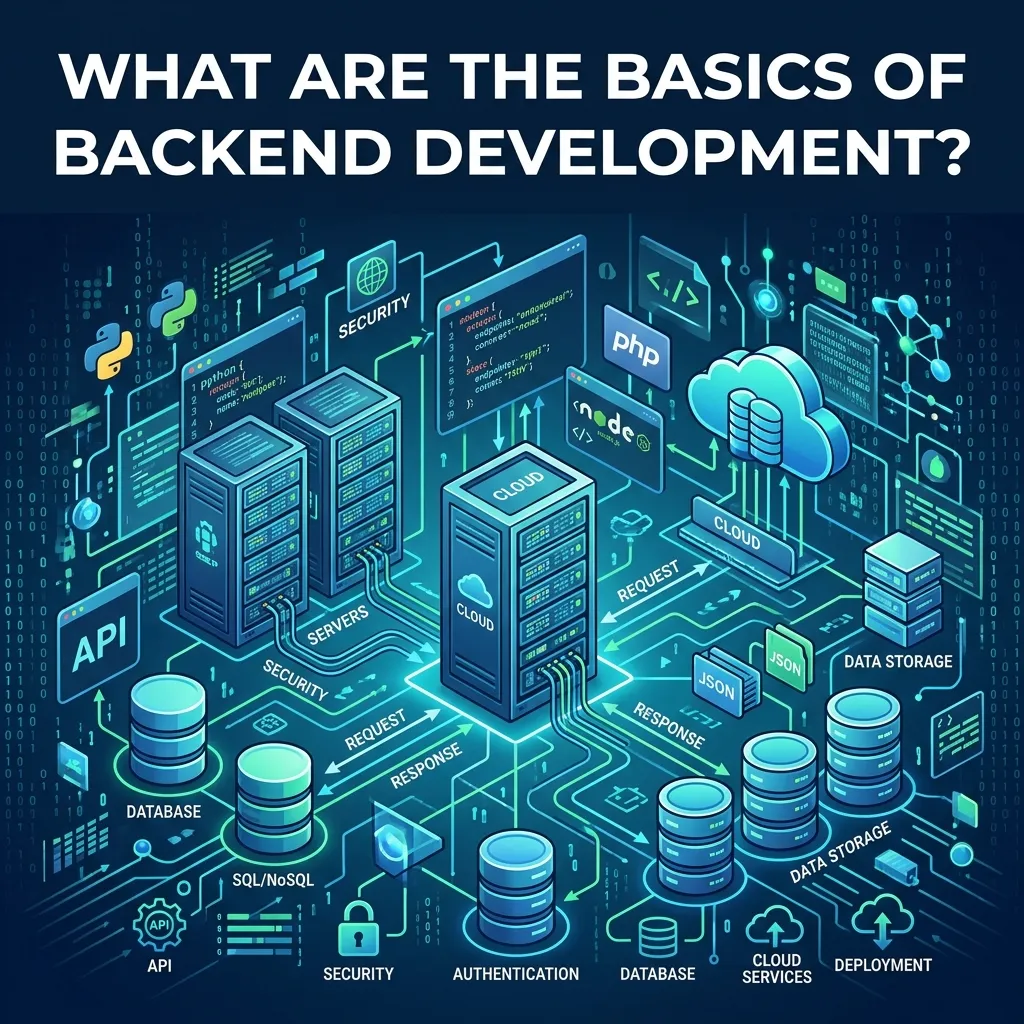
Backend development refers to the server-side layer of a web application. It encompasses everything users don’t see: the logic that processes requests, the databases that store information, and the systems that ensure everything runs securely and efficiently.
A backend typically consists of three core components:
- Server: The machine or cloud environment that receives and responds to client requests.
- Application: The logic layer that processes those requests—written in a backend programming language.
- Database: The system that stores, retrieves, and manages data.
Together, these components form what’s often called the “server-side stack.” The backend communicates with the frontend (the user-facing side) via APIs, exchanging data in formats like JSON or XML.
For developers who want to understand the broader application-building process, this web application development guide provides additional context
How Does Server-Side Development Work?
Server-side development is the process of writing code that runs on a server rather than in a user’s browser. When a user submits a form, clicks a button, or opens an app, a request travels from their device to a server. The server processes that request, interacts with the appropriate database, applies business logic, and returns a response.
This cycle happens in milliseconds—and making it fast, reliable, and secure is the core challenge of server-side development.
Key responsibilities of server-side development include:
- Authentication and authorization: Verifying who a user is and what they’re allowed to do.
- Business logic: Executing the rules that govern how data is created, modified, and accessed.
- Data processing: Transforming raw data into meaningful output for the frontend.
- Error handling: Managing failures gracefully so users experience minimal disruption.
Security should be considered throughout this process. Developers can explore these web application security best practices to better understand how to protect server-side applications and user data.
Which Backend Programming Languages Should You Learn?
Choosing the right backend programming language depends on your use case, team, and performance requirements. Here are the most widely used options:
Python
Python is known for its clean syntax and massive ecosystem of libraries. Frameworks like Django and Flask make it a popular choice for building APIs, data-driven applications, and machine learning-powered backends.
JavaScript (Node.js)
Node.js allows developers to use JavaScript on the server side, making it a natural choice for teams already working with JavaScript on the frontend. Its non-blocking, event-driven architecture makes it especially well-suited for real-time applications.
Java
Java has long been a backbone of enterprise backend development. It’s statically typed, highly scalable, and supported by mature frameworks like Spring Boot. Large organizations often favor Java for its performance and robustness.
Ruby
Ruby, paired with the Ruby on Rails framework, prioritizes developer speed and convention over configuration. It’s a strong choice for startups looking to move quickly.
PHP
PHP powers a significant portion of the web, including platforms like WordPress. While it has a complicated reputation, modern PHP (especially with frameworks like Laravel) is clean, powerful, and widely supported.
Go (Golang)
Go, developed by Google, is built for performance and concurrency. Its simplicity and speed make it an excellent choice for microservices and high-throughput systems.
What Backend Technologies and Frameworks Should You Know?
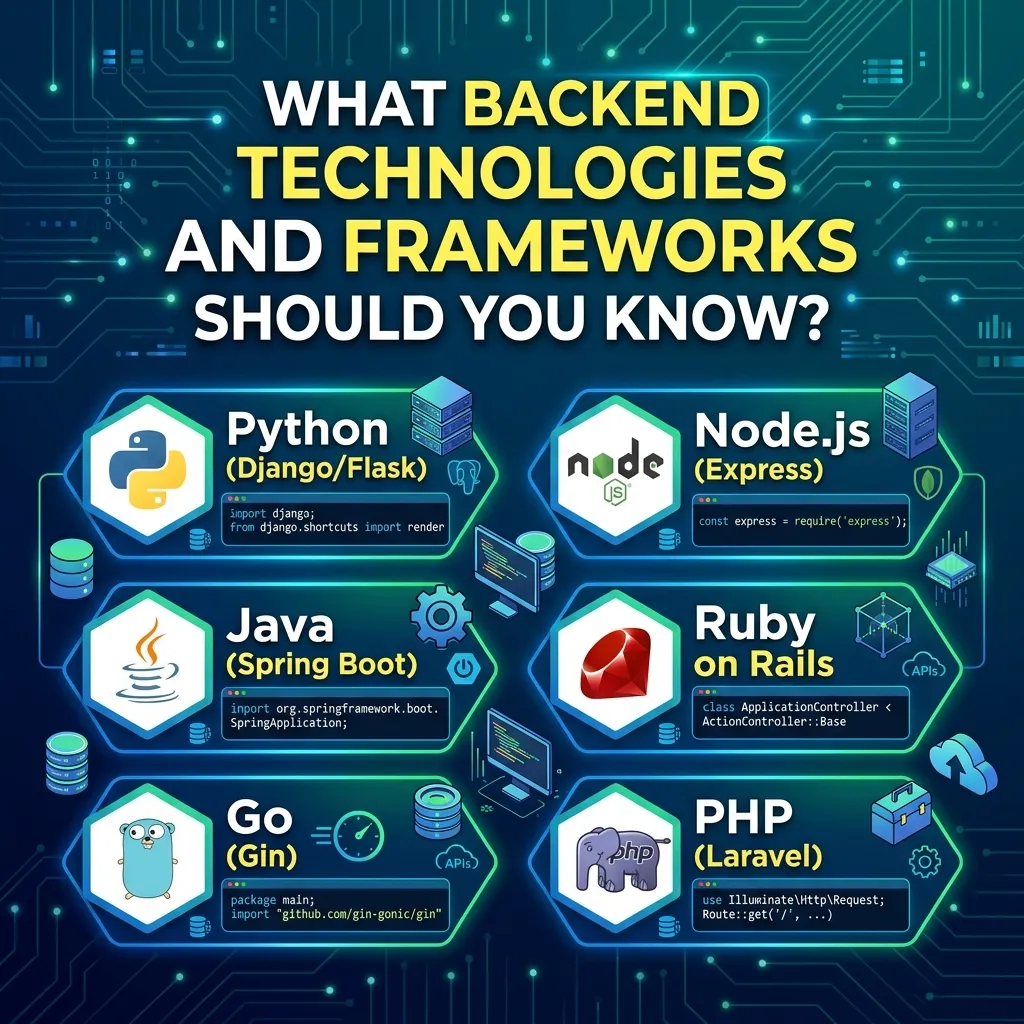
Beyond languages, backend developers rely on frameworks and technologies that accelerate development and enforce best practices.
Popular backend frameworks include:
- Django (Python): A batteries-included framework for building complex, data-heavy applications quickly.
- Express.js (Node.js): A minimal, flexible framework ideal for building APIs and microservices.
- Spring Boot (Java): A powerful framework for enterprise-grade applications with built-in security, dependency injection, and data management.
- Laravel (PHP): A full-featured framework with an elegant syntax and a rich ecosystem of tools.
- Ruby on Rails: A convention-driven framework that emphasizes productivity and clean code.
Choosing a framework means choosing a set of conventions, libraries, and trade-offs. A smaller framework like Express gives more flexibility; a larger one like Django provides more out of the box.
How Do APIs Work in Backend Development?
APIs (Application Programming Interfaces) are the connective tissue of modern applications. They define how different systems communicate—whether that’s a frontend talking to a backend, or two separate services exchanging data.
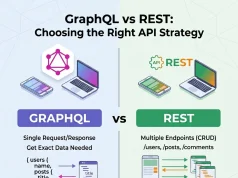
REST APIs
REST (Representational State Transfer) is the most common API architecture. RESTful APIs use standard HTTP methods (GET, POST, PUT, DELETE) and structure data as resources. They’re stateless, meaning each request contains all the information needed to process it.
GraphQL
GraphQL, developed by Meta, gives clients more control over what data they request. Instead of fixed endpoints, a GraphQL API exposes a single endpoint where clients specify exactly what fields they need. This reduces over-fetching and under-fetching of data.
gRPC
gRPC is a high-performance, open-source framework developed by Google. It uses Protocol Buffers instead of JSON, making it faster and more efficient—particularly suited for microservices communication.
Regardless of architecture, good API design prioritizes clarity, consistency, versioning, and thorough documentation.
What Is Database Management in Backend Development?
Databases are where applications store and retrieve information. Backend developers need to understand both how to design databases and how to interact with them efficiently.
Relational Databases (SQL)
Relational databases organize data into structured tables with predefined schemas. They use SQL (Structured Query Language) for queries and are ideal for applications with complex relationships and strict data integrity requirements. Examples include PostgreSQL, MySQL, and SQLite.
Non-Relational Databases (NoSQL)
NoSQL databases offer more flexibility by storing data in formats like documents, key-value pairs, graphs, or wide-column stores. They scale horizontally and handle unstructured data well. Examples include MongoDB, Redis, and Cassandra.
Choosing between SQL and NoSQL depends on your data structure and access patterns. SQL works best when relationships between data matter; NoSQL excels when flexibility and scale take priority.
Backend developers also work with ORMs (Object-Relational Mappers)—tools like SQLAlchemy, Sequelize, or ActiveRecord—that let them interact with databases using code instead of raw SQL queries.
What Are the Main Backend Architecture Patterns?
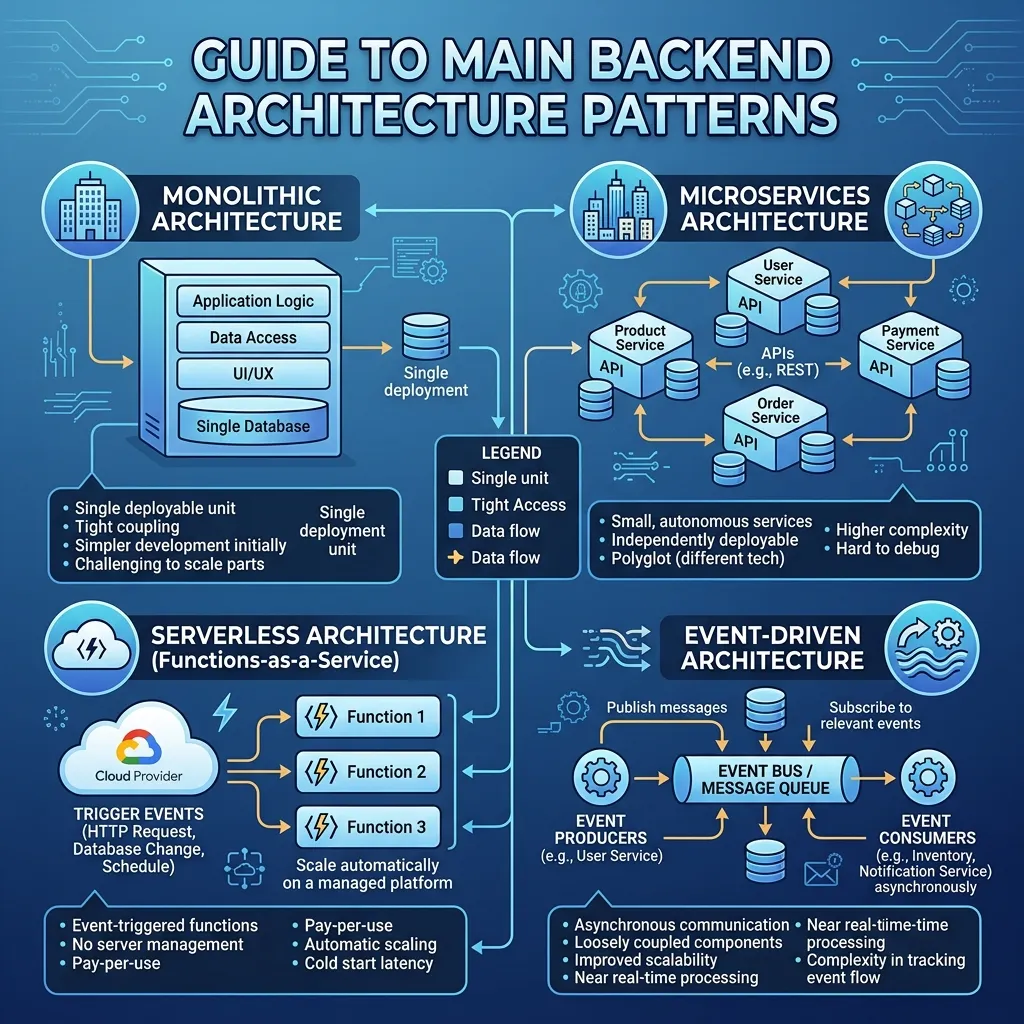
How you structure a backend application has enormous implications for scalability, maintainability, and developer experience.
Monolithic Architecture
In a monolithic application, all components—authentication, business logic, data access—live in a single codebase. Monoliths are simpler to build and deploy initially, making them a common starting point for new projects.
Microservices Architecture
Microservices break an application into small, independent services, each responsible for a specific function. This approach improves scalability and resilience but introduces complexity in deployment and inter-service communication.
Serverless Architecture
Serverless platforms (like AWS Lambda or Google Cloud Functions) let developers write individual functions that execute on demand. There’s no server to manage—the cloud provider handles scaling and infrastructure automatically.
Event-Driven Architecture
Event-driven systems use events (like “user registered” or “payment completed”) to trigger actions across services. This decouples components and enables highly scalable, asynchronous workflows.
Modern applications increasingly combine different architectural approaches depending on their requirements. Keeping up with current web technology trends can help developers understand how these approaches are evolving.
How Does Web Server Development Fit Into the Backend?
Web servers sit between clients and application code, handling incoming HTTP requests and routing them appropriately. Understanding web servers is essential for deploying and optimizing backend applications.
Nginx and Apache are the two most widely used web servers. Nginx excels at serving static content and handling high concurrency with low memory usage. Apache is highly configurable and has a mature ecosystem of modules.
Developers also use reverse proxies to route traffic, enforce SSL/TLS, and balance loads across multiple backend instances—improving both security and performance.
Containerization tools like Docker and orchestration platforms like Kubernetes have become standard in modern web server management, enabling consistent environments across development, staging, and production.
What Are Backend Development Best Practices?
Writing functional code is only part of the job. Backend developers who build systems that last follow a core set of principles:
- Write clean, modular code: Break logic into small, single-purpose functions and modules. This makes code easier to test, maintain, and reuse.
- Validate all input: Never trust data coming from clients. Validate and sanitize inputs at every entry point to prevent injection attacks and data corruption.
- Use environment variables: Store sensitive information—API keys, database credentials—in environment variables, never in source code.
- Implement proper error handling: Log errors with context, return meaningful error responses, and never expose stack traces to end users.
- Cache strategically: Use caching layers (like Redis or Memcached) to reduce database load and speed up frequently accessed data.
- Write tests: Unit tests, integration tests, and end-to-end tests catch bugs early and protect against regressions.
- Document your APIs: Good documentation reduces friction for frontend developers and third-party integrators. Tools like Swagger/OpenAPI make this straightforward.
- Monitor performance: Track response times, error rates, and resource utilization. Tools like Prometheus and Grafana help surface problems before they affect users.
What Are the Essential Backend Development Tools?
The right tools make backend development faster and more reliable. Here’s a breakdown of the essential categories:
|
Category |
Tools |
|---|---|
|
Version Control |
Git, GitHub, GitLab |
|
API Testing |
Postman, Insomnia, curl |
|
Containerization |
Docker, Kubernetes |
|
CI/CD |
GitHub Actions, Jenkins, CircleCI |
|
Monitoring |
Prometheus, Grafana, Datadog |
|
Database Management |
DBeaver, TablePlus, pgAdmin |
|
Logging |
ELK Stack (Elasticsearch, Logstash, Kibana), Loggly |
|
Package Management |
npm, pip, Maven, Composer |
Familiarity with these tools—even at a surface level—significantly boosts a backend developer’s ability to build, ship, and maintain production systems.
Build Backends That Last
Backend development is a craft that rewards patience, curiosity, and disciplined engineering habits. The fundamentals—server logic, APIs, databases, architecture—are learnable. What separates good backends from great ones is the attention paid to the details: clean code, thoughtful architecture, rigorous testing, and continuous performance monitoring.
Start by mastering one language and one framework. Build small projects. Expose an API. Connect a database. Then layer in more complexity as your confidence grows. The depth of backend development is vast, but every expert started by understanding how a request becomes a response.
Frequently Asked Questions
What is the difference between frontend and backend development?
Frontend development focuses on the user interface—what people see and interact with in a browser or app. Backend development handles server-side logic, databases, and APIs that power the frontend. Frontend developers work with HTML, CSS, and JavaScript; backend developers typically use languages like Python, Java, or Node.js.
Which backend programming language is best for beginners?
Python is widely considered the most beginner-friendly backend language. Its readable syntax, extensive documentation, and powerful frameworks—like Django and Flask—lower the barrier to entry significantly.
What is an API and why does it matter in backend development?
An API (Application Programming Interface) defines how a frontend or external system communicates with a backend. APIs are central to modern web development because they enable different systems to share data and functionality in a standardized way. Without APIs, backends and frontends couldn’t exchange information.
What is the difference between SQL and NoSQL databases?
SQL databases store data in structured tables with fixed schemas, making them ideal for applications with complex relationships. NoSQL databases store data in flexible formats (documents, key-value pairs, etc.) and scale more easily horizontally—better suited for unstructured or rapidly evolving data.
Is backend development harder than frontend development?
Neither is objectively harder—they require different skill sets. Backend development demands a strong grasp of server management, databases, security, and system design. Frontend development focuses on user experience, responsive design, and browser compatibility. Many developers eventually explore both (becoming full-stack developers).
What is the difference between monolithic and microservices architecture?
A monolithic architecture bundles all application functionality into a single codebase. Microservices split functionality into small, independently deployable services. Monoliths are simpler to start with; microservices offer better scalability and resilience at the cost of added operational complexity.
What is backend development?
Backend development focuses on the server-side systems that power web applications, including databases, APIs, authentication, and business logic.
What does a backend developer do?
A backend developer builds and maintains server-side applications, manages databases, creates APIs, handles authentication, and ensures applications remain secure and reliable.
Which backend programming language is best for beginners?
Python is a popular choice for beginners because of its simple syntax, extensive resources, and frameworks such as Django and Flask.
What are the most popular backend languages?
Popular backend languages include Python, JavaScript with Node.js, Java, PHP, Ruby, and Go.
What is an API in backend development?
An API allows different software systems to communicate and exchange data. REST, GraphQL, and gRPC are common approaches to building APIs.
What databases are used in backend development?
Backend developers commonly use SQL databases such as PostgreSQL and MySQL, as well as NoSQL databases such as MongoDB, Redis, and Cassandra.
What is the difference between SQL and NoSQL?
SQL databases use structured tables and predefined schemas, while NoSQL databases provide more flexible data models and are often useful for applications requiring flexible or large-scale data storage.
What is the difference between monolithic and microservices architecture?
A monolithic application keeps its major components in one codebase, while microservices divide an application into smaller, independently deployable services.
What tools should a backend developer learn?
Useful tools include Git, GitHub, Postman, Docker, Kubernetes, database management tools, CI/CD platforms, and monitoring solutions such as Prometheus and Grafana.
How can I start learning backend development?
Start by learning one programming language, then choose a framework and build small projects. Practice creating APIs, connecting databases, implementing authentication, and testing your applications as you progress.



[…] Businesses planning a custom application should understand the role of the backend development process. […]
[…] applications with complex backend requirements, this backend development guide for beginners provides useful development […]
[…] business logic, data processing, and communication with databases and external services. This backend development guide for beginners covers the core concepts — servers, APIs, databases — that underpin nearly every backend […]